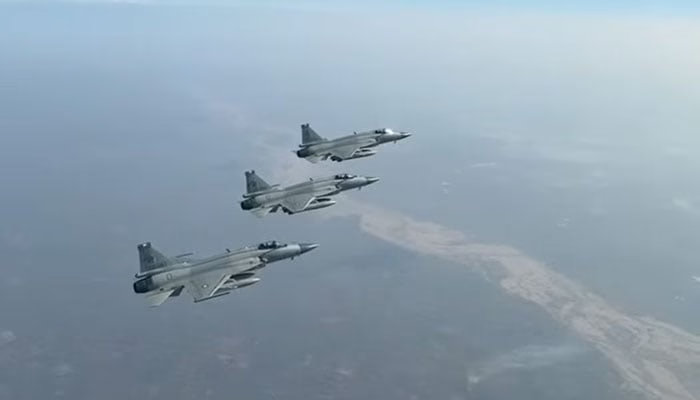
The Pakistan Air Force (PAF) has once again demonstrated its operational strength and future-ready capabilities through Exercise Golden Eagle, successfully conducted in the Southern Air Command’s area of responsibility. According to the Inter-Services Public Relations (ISPR), the large-scale exercise was designed to validate combat readiness, operational agility, and the ability to operate effectively in a rapidly evolving security environment.
From the very start, Exercise Golden Eagle was structured to test the full spectrum of PAF’s combat potential. Conducted on a Two-Force construct, the exercise emphasized modern warfare concepts such as AI-enabled and net-centric operations. These elements reflect the shifting nature of air combat, where information dominance, speed, and precision are just as critical as traditional kinetic power.
A defining feature of the exercise was the integration of indigenous niche, disruptive, and smart technologies. By leveraging locally developed solutions, the PAF highlighted its growing emphasis on self-reliance and innovation. This approach not only strengthens operational independence but also ensures adaptability against emerging regional security challenges. In the context of Exercise Golden Eagle, these technologies were tested under realistic and demanding operational conditions.
Operating within a robust integrated air defence system, friendly forces focused on shaping the battlespace through a seamless fusion of kinetic and non-kinetic operations. Cyber warfare, space-based capabilities, and operations across the electro-magnetic spectrum were synchronized with traditional air combat missions. This multi-domain integration underscored the PAF’s understanding that modern conflicts are no longer confined to a single domain, making Exercise Golden Eagle a comprehensive test of joint operational effectiveness.
The kinetic phase of the exercise showcased advanced air combat capabilities. Swing-role combat aircraft executed “First-Shoot, First-Kill” missions, supported by long-range beyond-visual-range (BVR) air-to-air missiles and extended-range stand-off weapons. Precision strike capabilities were also a central focus, ensuring accuracy and effectiveness while minimizing collateral damage. These missions were further enhanced by airborne early warning and control platforms and air-to-air refuellers, enabling sustained and high-tempo operations during Exercise Golden Eagle.
One of the most significant highlights of the exercise was the successful implementation of Manned–Unmanned Teaming. Deep-reach killer drones and loitering munitions operated alongside manned aircraft in a highly contested, congested, and degraded environment. This validated the PAF’s ability to integrate unmanned systems into complex combat scenarios, a capability increasingly vital in modern warfare. The success of these operations during Exercise Golden Eagle reflects a strong alignment with global air power trends.
Command and control played a critical role throughout the exercise. All operations were executed under a unified command structure from the Next-Generation All-Domain Command and Control Centre at Air Headquarters in Islamabad. This centralized yet agile command framework ensured real-time situational awareness, faster decision-making, and effective coordination across multiple domains. Such a structure is essential for managing complex operations like Exercise Golden Eagle, where speed and accuracy can determine mission success.
Beyond tactical achievements, the exercise carried strategic significance. It sent a clear message about the PAF’s preparedness to counter both current and future threats. By validating high-tempo operations and testing advanced technologies in realistic scenarios, Exercise Golden Eagle reaffirmed the PAF’s commitment to maintaining a high state of readiness while continuously evolving its operational doctrines.
The successful conduct of the exercise also highlighted the importance of training and human capital. Advanced platforms and technologies can only deliver results when operated by well-trained personnel. Exercise Golden Eagle provided air and ground crews with invaluable experience in complex, multi-domain operations, further sharpening their skills and enhancing overall force effectiveness.
Exercise Golden Eagle stands as a strong testament to the Pakistan Air Force’s operational preparedness, technological integration, and forward-looking approach to air warfare. By combining indigenous innovation, AI-enabled systems, manned–unmanned teaming, and unified command and control, the PAF demonstrated its ability to operate decisively in modern conflict environments. As regional and global security dynamics continue to evolve, exercises like this ensure that the PAF remains agile, capable, and ready to meet emerging challenges head-on.