The Islamabad Imambargah suicide attack has taken a significant turn after intelligence agencies, working closely with law enforcement agencies (LEAs), arrested four key facilitators, including the alleged mastermind behind the deadly blast at Khadijah al-Kubra Imambargah. The arrests mark a major breakthrough in an investigation that shocked the nation and claimed dozens of innocent lives during Friday prayers.
According to security sources, the mastermind of the Islamabad Imambargah suicide attack is an Afghan national affiliated with Daesh. Investigators revealed that the attacker was trained and radicalised in Afghanistan, highlighting growing concerns that militant networks operating from across the border continue to pose a serious threat to regional and global peace.
The Attack and Its Human Cost
The suicide blast took place at the entrance of Khadijah al-Kubra Imambargah in Islamabad’s Tarlai area, where the attacker detonated himself after opening fire. At least 33 worshippers were martyred, while dozens sustained injuries. The brutality of the Islamabad Imambargah suicide attack has left families grieving and raised fresh questions about security during religious gatherings.
During follow-up operations, one security personnel embraced martyrdom, and three others were injured while confronting facilitators linked to the attack. Funeral prayers for several victims were held in Islamabad, attended by federal ministers, officials, and large numbers of citizens, reflecting the collective mourning and resolve against terrorism.
Identity of the Attacker and Initial Findings
Investigators recovered the suspected bomber’s identity card from the blast site. Nadra records identified him as Yasir, 32, a resident of Peshawar. Further investigation revealed that Yasir was not acting alone but was part of an organised facilitation network.
Security officials confirmed that the Islamabad Imambargah suicide attack was planned, trained, and ideologically driven by Daesh operatives based in Afghanistan. Yasir had reportedly travelled to Afghanistan in May and returned in June, where he was indoctrinated and prepared for the attack.
Facilitation Network and Arrests
Authorities have so far arrested four facilitators, including Yasir’s brother-in-law, who remained in constant contact with him. The attacker’s mother has also been taken into custody in Islamabad as investigations widened to dismantle the entire support structure behind the operation.
Sources said Yasir activated a new mobile SIM in Bajaur in June 2025 and remained there until October. He later moved to Nowshera’s Hakimabad area, from where he conducted reconnaissance of the targeted imambargah. Surveillance and target selection reportedly continued for several weeks before the Islamabad Imambargah suicide attack was executed.
Planning, Movement, and Execution
Investigators reconstructed the attacker’s movements in detail. Yasir travelled from Nowshera to Islamabad using public transport while wearing a suicide vest. Before reaching the imambargah, he briefly stayed at a nearby hotel. He then walked to the site from Khanna Road.
Police sources revealed that Yasir fired two bullets while approaching the area and four more after entering the imambargah. All bullet casings were recovered from the scene. Forensic analysis confirmed that four to five kilograms of explosives were used, packed with a large number of ball bearings to maximise casualties.
Nowshera Operation and Ongoing Investigation
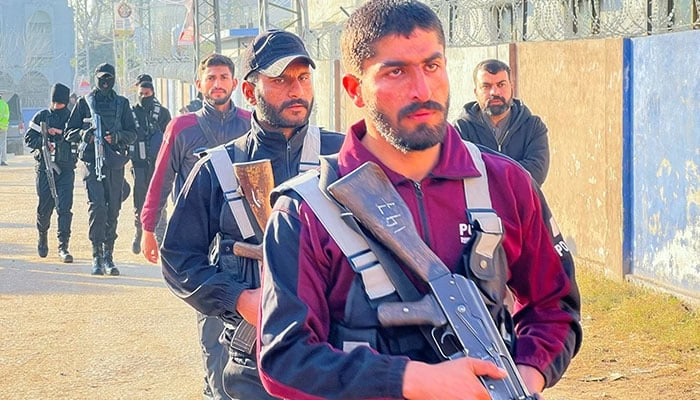
In a related counterterrorism operation in Nowshera, Regional Police Officer Rab Nawaz Khan confirmed that one terrorist was killed and three suspects were arrested. The operation targeted individuals suspected of facilitating the Islamabad Imambargah suicide attack. Investigations are ongoing, and authorities believe further arrests are likely as intelligence leads are pursued.
During the Hakimabad operation, an assistant sub-inspector was martyred, while another ASI and a constable were injured. Their sacrifice underscores the high cost paid by security forces in protecting civilians and dismantling terror networks.
Broader Security Implications
The case has once again drawn attention to the cross-border dimension of militancy. Security officials stressed that groups like Daesh, operating under the shadow of instability in the region, continue to exploit vulnerable individuals through training and brainwashing. The Islamabad Imambargah suicide attack has reinforced the urgency of intelligence coordination, border security, and counter-extremism efforts.
The arrest of the mastermind and key facilitators behind the Islamabad Imambargah suicide attack represents a crucial step toward justice for the victims. While the pain of loss remains deep, the successful intelligence-led operations demonstrate the state’s resolve to confront terrorism. As investigations continue, authorities have vowed to bring all those involved to account and strengthen measures to prevent such tragedies in the future.