The issue of Imran Khan medical access has once again come into the spotlight after an anti-terrorism court (ATC) in Rawalpindi rejected a request to allow the PTI founder to be examined by his personal doctors while in prison. The court’s decision has fueled debate over prisoner rights, legal procedures, and the balance between law and humanitarian considerations in high-profile political cases.
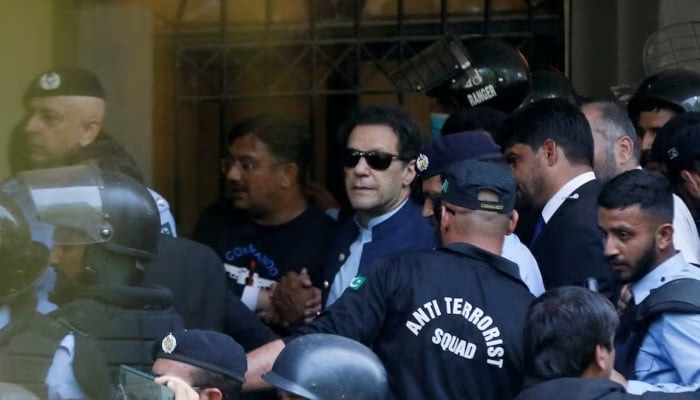
The ruling came during a hearing of the May 9 General Headquarters (GHQ) attack case, presided over by ATC Judge Amjad Ali Shah. Imran Khan’s legal counsel, Faisal Malik, argued that his client should be allowed access to his trusted medical team due to ongoing health concerns. However, the prosecution firmly opposed the request, leading to the dismissal of the petition.
Court’s Reasoning Behind the Decision
Special Prosecutor Zaheer Shah told the court that Imran Khan is an under-trial prisoner who is currently on bail in the GHQ attack case, not a convicted inmate in that specific matter. He argued that a criminal court does not have jurisdiction to regulate the custody arrangements or medical access of a suspect who is on bail.
The prosecutor further cited Pakistan Prison Rules, stating that the law does not provide for personal doctors to examine prisoners. According to him, private medical care is not part of the existing legal framework governing prisons. Based on these arguments, the court concluded that there was no legal basis to grant special medical access, resulting in the rejection of the request. This decision has become a central point in the ongoing discussion around Imran Khan medical access.
Health Concerns and Recent Medical Procedure
The controversy is closely linked to Imran Khan’s recent health issues. He underwent an eye procedure at the Pakistan Institute of Medical Sciences (PIMS) in Islamabad, where doctors reportedly found that pressure in blood vessels had affected his vision. According to PTI leaders, medical professionals warned that delaying the procedure could have resulted in permanent vision loss.
PTI chairman Barrister Gohar Khan, quoting messages from Imran Khan’s wife Bushra Bibi, said the former prime minister’s health improved following the treatment. However, the party accused authorities of withholding details of his medical condition for several days, adding to concerns about transparency and timely care. These developments have intensified calls for broader Imran Khan medical access to independent and trusted doctors.
Political and Legal Reactions
The issue has also drawn attention at the political level. National Assembly Opposition Leader Mahmood Khan Achakzai wrote to Prime Minister Shehbaz Sharif, urging him to intervene and ensure that Imran Khan is examined by his personal medical team. In his letter, Achakzai emphasized that recent medical check-ups were conducted without the presence or knowledge of Imran’s family or personal physicians.
Achakzai argued that comprehensive medical examinations by trusted doctors are “critically needed” to properly assess and manage Imran Khan’s health. He cited medical ethics, legal obligations, and fundamental human rights, urging that doctors from Shaukat Khanum Hospital, Shifa Hospital, and other reputable institutions be allowed access. These demands have kept the debate over Imran Khan medical access alive in both legal and political circles.
Jail Administration’s Position
In response to criticism, the Adiala Jail administration clarified that Imran Khan is being provided all facilities available to B-Class prisoners under the law. According to officials, these include tailored meals, routine healthcare, reading materials, exercise, and regular walks. They maintain that his treatment is in line with prison rules and that no legal discrimination is taking place.
However, Imran Khan’s family has countered these claims, stating that his personal physician has not been allowed to examine him for more than a year. They argue that routine prison healthcare cannot replace detailed assessments by doctors who are familiar with his medical history.
Broader Context of Imran Khan’s Incarceration
Imran Khan, now 72, has been in jail since August 2023 following convictions in multiple cases. He maintains that all charges against him are politically motivated and stem from his removal from office through a parliamentary vote in 2022. His first conviction related to the Toshakhana case, involving allegations of unlawfully selling state gifts.
Subsequent convictions added lengthy sentences, including 10 years for leaking a diplomatic cable and 14 years in a graft case connected to the Al-Qadir Trust. Prosecutors allege improper land deals linked to the charity, while Imran Khan has denied all accusations. As legal proceedings continue, the question of Imran Khan medical access remains intertwined with broader concerns about justice, rights, and political accountability.
The ATC’s rejection of the request for personal doctors marks another significant development in Imran Khan’s legal journey. While authorities insist that all lawful facilities are being provided, supporters argue that medical autonomy and transparency are essential, especially given his age and health issues. As courts continue to hear cases against him, the debate over Imran Khan medical access is likely to persist, reflecting deeper tensions between law, politics, and human rights in Pakistan.