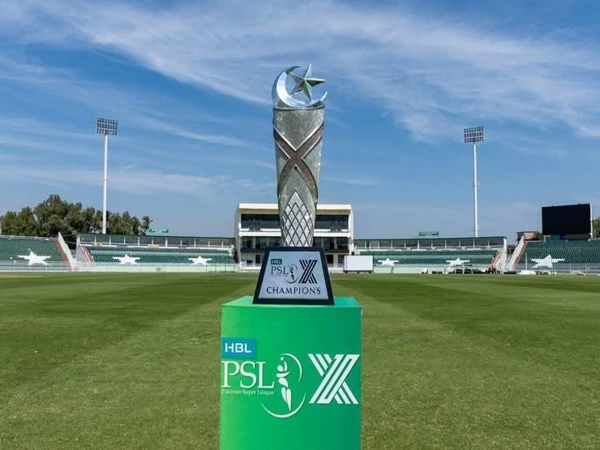
The announcement that PSL 11 broadcast ban in India will be in effect has sparked widespread discussion among cricket fans and media circles. According to sources, the Pakistan Cricket Board (PCB) has decided not to sell television and digital broadcasting rights for the eleventh edition of the Pakistan Super League in the Indian region, meaning the tournament will be telecast worldwide except in India.
This decision marks a significant development for the league, which has steadily grown into one of the most-watched T20 tournaments globally. The PSL 11 broadcast ban in India means that Indian cricket fans, who have historically followed the league closely due to shared cricketing culture and interest in players, will no longer be able to watch matches through official channels.
PCB’s Decision on Broadcasting Rights
Sources indicate that the PCB made a strategic decision to withhold the sale of PSL broadcast rights in India, while continuing to market and sell those rights across all other international regions. As a result, PSL 11 matches will be available live in Pakistan, the Middle East, Europe, the United States, Australia, and other cricket-following markets.
The board has not issued a detailed public explanation, but industry observers believe the move is linked to broader political and commercial considerations. Regardless of the reasoning, the PSL 11 broadcast ban in India sets this season apart from previous editions, which were accessible to Indian audiences through satellite TV and online platforms.
Impact on Indian Cricket Fans
For Indian cricket fans, the decision is disappointing. Over the years, PSL has attracted viewership in India due to the presence of international stars, competitive cricket, and high production quality. Many Indian fans followed PSL not only for entertainment but also to watch emerging Pakistani talent and foreign players not always featured in the Indian Premier League (IPL).
With the PSL 11 broadcast ban in India, fans may turn to unofficial streams or social media highlights, though these options lack the experience of live, high-quality coverage. The absence of official broadcasts also reduces engagement through commentary, expert analysis, and pre- and post-match shows that enhance the viewing experience.
Global Reach Remains Strong
Despite the Indian blackout, PSL 11 is expected to enjoy strong global coverage. The league has steadily expanded its international footprint, with broadcasters in multiple regions securing rights to show matches live. Digital platforms and sports networks will ensure that fans across continents can follow the action in real time.
The PCB appears confident that the league’s growing popularity, combined with new teams and fresh talent, will keep international interest high even without the Indian market. From a branding perspective, the PSL 11 broadcast ban in India may reduce total viewership numbers, but it is unlikely to derail the league’s overall momentum.
Expanded Format With Eight Teams
PSL 11 will also be historic for another reason: the expansion of the league to eight teams. Two new franchises have been added, increasing the total number of teams from six to eight. This expansion promises more matches, new rivalries, and broader regional representation within Pakistan.
A larger league format is expected to boost competitiveness and provide more opportunities for local players to showcase their skills. For international audiences, it also means a longer tournament with greater variety. Even with the PSL 11 broadcast ban in India, this expanded format could help offset viewership losses by attracting fans from other regions.
First-Ever Players’ Auction
Another milestone for PSL 11 is the introduction of a players’ auction system, scheduled to take place on February 11. For the first time in the league’s history, teams will build their squads through an auction rather than the traditional draft model.
This change is aimed at increasing transparency, competitiveness, and fan engagement. Auctions often generate excitement, debate, and media attention, adding to the buildup before the tournament begins. The innovation shows that the PCB is willing to evolve the league’s structure to keep it fresh and globally relevant, even amid challenges like the PSL 11 broadcast ban in India.
Tournament Schedule and Expectations
The eleventh edition of the Pakistan Super League is set to begin on March 26. Matches will be played across multiple venues, with top local and international players expected to participate. Fans can anticipate high-intensity cricket, packed stadiums, and strong digital engagement.
While the absence of Indian broadcasts is notable, the PCB appears focused on strengthening the league’s identity and expanding its reach elsewhere. Over time, the success of PSL 11 may depend less on a single market and more on its ability to deliver consistent quality and innovation.
The PSL 11 broadcast ban in India represents a significant shift in the league’s broadcasting strategy and has clear implications for fans and viewership numbers. However, with global telecast coverage, an expanded eight-team format, and the introduction of a players’ auction, PSL 11 is shaping up to be one of the most dynamic seasons yet. While Indian fans may miss out on live action, the league’s growth trajectory suggests that the Pakistan Super League is continuing to evolve as a major force in international T20 cricket.