Pakistan Kazakhstan relations entered a new phase as President Kassym-Jomart Tokayev arrived in Islamabad for a two-day official visit, signaling growing diplomatic and economic engagement between the two countries. The Pakistan Kazakhstan relations agenda is firmly in focus, with both sides aiming to deepen cooperation across trade, connectivity, and regional collaboration.
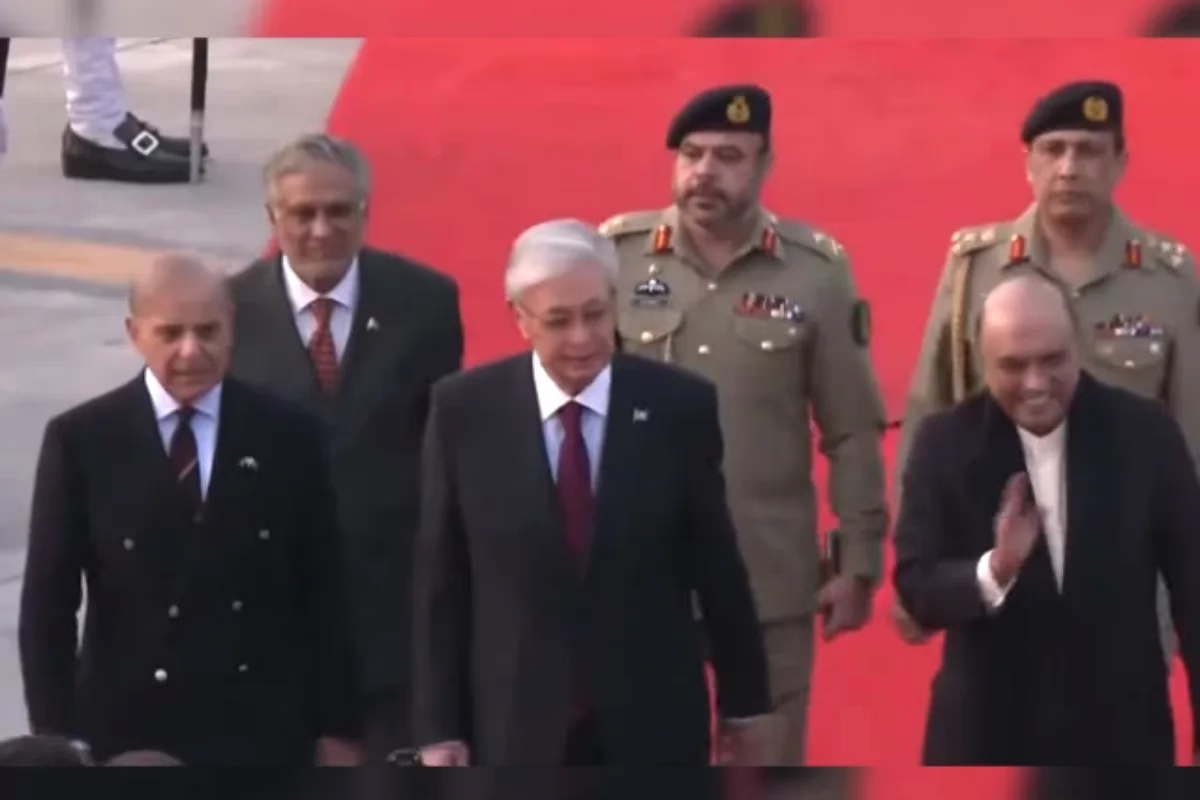
President Tokayev landed at Nur Khan Airbase, where he was warmly received by President Asif Ali Zardari, Prime Minister Shehbaz Sharif, and Deputy Prime Minister and Foreign Minister Senator Ishaq Dar. The high-profile reception reflected the importance Pakistan places on its ties with Kazakhstan and Central Asia more broadly. Accompanied by a high-level delegation including senior cabinet ministers and top officials, the Kazakh president’s visit underscores the seriousness of bilateral intent.
At the heart of the visit are high-level meetings with Pakistan’s leadership. President Tokayev is scheduled to hold talks with President Zardari and Prime Minister Shehbaz Sharif, focusing on a comprehensive review of bilateral relations. These discussions are expected to identify new avenues for cooperation and to translate political goodwill into tangible outcomes that benefit both economies.
A key highlight of the visit is President Tokayev’s address at the Pakistan-Kazakhstan Business Forum. This forum brings together business leaders, investors, and policymakers from both sides, aiming to unlock trade potential that remains largely untapped. Despite strong diplomatic ties, trade volumes between Pakistan and Kazakhstan have historically been modest. Both governments now see significant room for growth, particularly in sectors such as agriculture, energy, pharmaceuticals, textiles, and information technology.
The Ministry of Foreign Affairs described the visit as a timely opportunity to broaden cooperation, especially in trade, logistics, and regional connectivity. Improving transport and logistics links is central to strengthening Pakistan Kazakhstan relations, as geography has long been a limiting factor. Kazakhstan’s position as a landlocked Central Asian state and Pakistan’s access to Arabian Sea ports create natural complementarities. Enhanced connectivity could allow Kazakhstan to access global markets through Pakistani ports, while Pakistan could gain greater access to Central Asian markets.
Regional connectivity is also linked to wider initiatives involving Central and South Asia. Both countries have expressed interest in being part of transit and trade corridors that promote economic integration and stability. In this context, discussions during the visit are expected to touch on infrastructure development, road and rail links, and cooperation within regional frameworks.
Beyond economics, people-to-people contacts form another important pillar of the relationship. Cultural exchanges, educational cooperation, and tourism promotion are increasingly seen as tools to strengthen mutual understanding. Pakistan and Kazakhstan share historical and cultural affinities rooted in broader Islamic and Eurasian heritage, which both governments want to transform into stronger societal links.
The visit also reflects growing alignment at regional and international forums. Pakistan and Kazakhstan often share perspectives on issues such as regional peace, multilateral cooperation, and economic development. Strengthening coordination in organizations like the United Nations, the Organization of Islamic Cooperation, and other regional platforms is expected to be part of the dialogue.
This visit builds on recent momentum in bilateral ties. In September, during the visit of then-Kazakh Deputy Prime Minister Murat Nurtleu to Pakistan, the two countries signed an Action Plan of Cooperation. That roadmap laid out concrete steps to enhance collaboration across multiple sectors. President Tokayev’s visit is widely seen as an effort to advance and operationalize that action plan at the highest political level.
For Pakistan, deeper engagement with Kazakhstan fits into its broader strategy of strengthening ties with Central Asian states. Islamabad views Central Asia as a region of strategic economic importance, offering energy resources, new markets, and opportunities for regional integration. Kazakhstan, as the largest economy in Central Asia, is a natural partner in this approach.
For Kazakhstan, Pakistan represents a gateway to South Asia and beyond. Access to Pakistani ports, a large consumer market, and growing industrial capacity make Pakistan an attractive partner. Strengthening Pakistan Kazakhstan relations therefore serves the long-term strategic and economic interests of both nations.
President Kassym-Jomart Tokayev’s visit marks a significant step forward in bilateral ties. By focusing on trade, connectivity, and people-to-people links, Pakistan and Kazakhstan are moving toward a more substantive and results-oriented partnership. If the commitments discussed during this visit are effectively implemented, the relationship has the potential to evolve from cordial diplomacy into a robust, multidimensional cooperation that contributes to regional peace and prosperity.