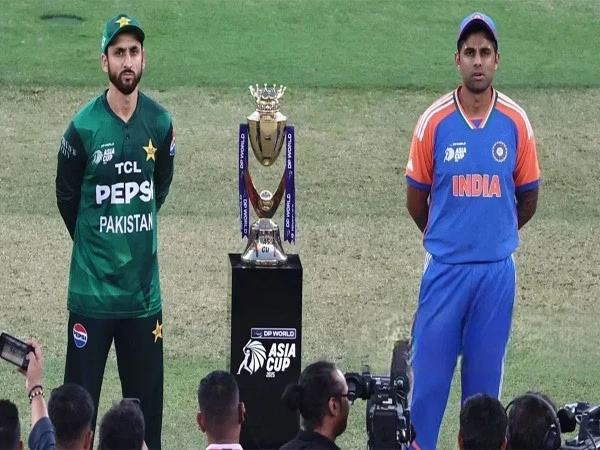
The India Pakistan T20 World Cup match revenue has become the center of intense debate after Pakistan announced it would not play against India in the upcoming T20 World Cup. This single decision has sent ripples through the cricketing world, particularly in India, where the match is viewed not just as a sporting contest but as the financial backbone of the entire tournament.
In modern cricket, a few fixtures transcend sport, and the India–Pakistan clash is the biggest of them all. The India Pakistan T20 World Cup match revenue is estimated at around $500 million, generated through broadcast rights, premium advertising, sponsorship activations, ticket sales, and related commercial activities. No other match in the tournament comes close to this level of economic impact, which explains the scale of the reaction following Pakistan’s announcement.
For broadcasters, this fixture is the ultimate asset. Television networks bid aggressively for World Cup rights largely because of this single game. During an India–Pakistan encounter, a 10-second advertisement can cost between 2.5 and 4 million Indian rupees, a rate unmatched by any other match in the competition. Without this fixture, the entire valuation model of the tournament is disrupted. The India Pakistan T20 World Cup match revenue effectively underwrites the high prices paid for broadcasting rights.
Indian media reports suggest that advertising alone during this match generates nearly 3 billion Indian rupees. This income helps broadcasters recover their investment quickly, allowing them to profit from the rest of the tournament. If the match is not played, the first financial blow falls on the rights holders, who then look to the International Cricket Council (ICC) for compensation under existing agreements.
This is where the issue becomes global rather than bilateral. The ICC relies heavily on the India Pakistan T20 World Cup match revenue to sustain its financial ecosystem. A significant portion of ICC earnings is redistributed to full and associate member boards, many of which do not have strong commercial markets of their own. When this revenue stream is removed, the ICC’s ability to support smaller boards is severely weakened.
Pakistan and India themselves would also face reduced earnings, but the wider impact would be felt by cricket boards across Africa, Asia, and Europe. These boards depend on ICC distributions to fund domestic cricket, player development, and grassroots programs. In that sense, the absence of a single high-profile match can have consequences far beyond the two teams involved.
What makes this situation unique is that the match’s importance is not tied to sporting stakes alone. Even a group-stage India–Pakistan game often attracts more viewers and revenue than a World Cup final involving other teams. The India Pakistan T20 World Cup match revenue essentially subsidizes less-watched fixtures, allowing the tournament to remain commercially viable as a whole.
From a financial perspective, removing this match is equivalent to removing the engine from a vehicle and expecting it to run normally. Broadcasters structure advertising packages, sponsorship bundles, and audience projections around this one game. When it disappears, those calculations collapse, forcing renegotiations, refunds, and potential legal disputes.
At the same time, this episode highlights a deeper issue in global cricket: overdependence on a single rivalry. While the India–Pakistan clash brings enormous attention and money, it also exposes the sport’s vulnerability. The current uproar shows how much the global cricket economy leans on the India Pakistan T20 World Cup match revenue, rather than a diversified set of commercially strong fixtures.
In the long run, this may prompt the ICC and cricket boards to rethink their financial strategies. Building stronger rivalries, expanding markets, and making other matches commercially attractive could reduce reliance on one high-stakes game. Until then, decisions affecting this fixture will continue to carry disproportionate economic weight.
Pakistan’s decision not to play India in the T20 World Cup is not just a sporting or political matter; it is a financial shockwave. The India Pakistan T20 World Cup match revenue has become so central to modern cricket that its absence threatens broadcasters, the ICC, and smaller cricketing nations alike. This situation serves as a clear reminder that in today’s cricket economy, some matches are not just games they are entire business models.