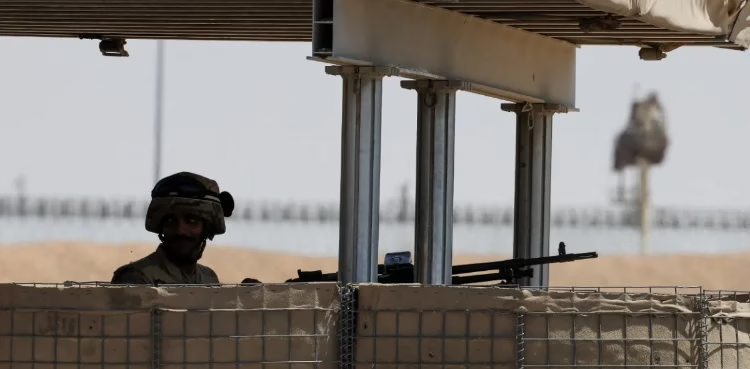
Palestinians on Monday awaited a full reopening of the Rafah crossing between Gaza and Egypt after Israel partially resumed operations a day earlier, nearly two years after taking control of the key border point during the war with Hamas.
The reopening began Sunday under a tightly restricted pilot phase, following months of appeals from humanitarian organisations. Israeli state broadcaster Kan reported that around 150 people were expected to leave Gaza for Egypt, including 50 patients, while about 50 individuals were also set to enter the territory. The crossing is expected to operate for around six hours daily.
AFP footage showed ambulances lined up on the Egyptian side, ready to receive medical evacuees. Gaza’s health ministry said around 200 patients are currently waiting for approval to leave for treatment abroad.
“The Rafah crossing is a lifeline,” said Mohammed Nassir, a Palestinian who lost his leg early in the war and requires surgery unavailable in Gaza.
Rafah is a crucial route for humanitarian aid into Gaza, where conditions remain dire despite a ceasefire in place since October 10. The crossing had been closed since May 2024, when Israeli forces seized control, aside from a brief reopening in early 2025.
Israel’s defence ministry body COGAT said movement of individuals “in both directions” was expected to begin but did not announce any large-scale aid flow. In contrast, Egypt’s state-linked Cairo News reported that the Egyptian side of the crossing would remain open around the clock, with hospitals prepared to receive patients from Gaza.
Meanwhile, Egypt and Jordan reaffirmed their rejection of any displacement of Palestinians from Gaza. Israel had earlier linked Rafah’s reopening to the recovery of the remains of Israeli hostage Ran Gvili, whose body was returned and buried last week.
Violence continued ahead of the reopening, with Gaza’s civil defence reporting at least 32 deaths in Israeli attacks on Saturday. Israel said it responded after militants emerged from a tunnel in Rafah.
Israel also announced it was terminating Doctors Without Borders’ humanitarian operations in Gaza after the organisation refused to provide a list of Palestinian staff, citing safety concerns.
Rafah remains Gaza’s only crossing not directly controlled by Israel, making its reopening critical for medical evacuations and humanitarian relief as Israeli forces continue to control more than half of the territory.