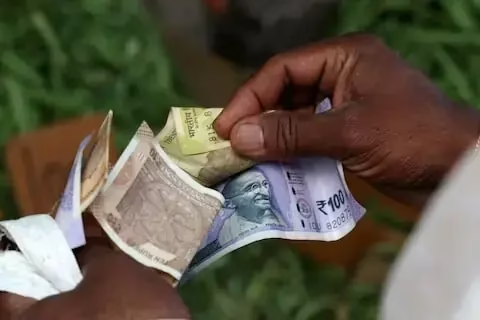
The Indian rupee outlook for Friday remains cautious as the currency is expected to open on the defensive amid weak Asian market sentiment, rising oil prices, and persistent flow-related pressures. Traders believe the Reserve Bank of India (RBI) will continue to act as a crucial backstop, but confidence is growing that the 92-per-dollar level may not be an unbreakable barrier.
Early market indicators suggest the rupee could open in the range of 91.90 to 91.96 against the U.S. dollar. The one-month non-deliverable forward market shows clear vulnerability, reflecting expectations that the currency could test new lows if pressures persist.
Record Low Signals Stress
On Thursday, the rupee touched an all-time low of 91.9850, highlighting the intense stress on the currency. The fall was driven by strong dollar demand linked to non-deliverable forward (NDF) maturities and a long-standing imbalance between dollar demand and supply in the local market.
Bankers noted that without sustained intervention from the RBI, the rupee could have weakened further. The central bank reportedly sold dollars aggressively to prevent a clean break above the psychologically important 92-per-dollar mark. This intervention has become a defining feature of the current Indian rupee outlook, offering short-term stability but raising questions about how long such defense can be maintained.
RBI’s Role: A Soft Line of Defense
Market participants broadly expected the RBI to step in near 92, viewing it as a key psychological and policy-sensitive level. However, traders caution that this does not mean the level will be defended at all costs.
Recent price action suggests the central bank may allow gradual depreciation rather than aggressively burn reserves to hold a specific line. This approach aligns with the RBI’s past behavior of smoothing volatility rather than fixing exchange rates. As a result, the Indian rupee outlook points to controlled weakness rather than a sharp collapse, unless external shocks intensify.
Domestic Factors Driving Weakness
The rupee has already declined around 2.3% this month, putting it on track for its worst monthly performance since September 2022. Unlike some previous episodes, this weakness is being driven largely by domestic factors.
Bankers point to increased dollar demand from banks linked to gold and bullion imports, which tend to rise during periods of high global prices and strong local demand. At the same time, persistent equity outflows have reduced foreign currency inflows, adding to the pressure.
Another key issue shaping the Indian rupee outlook is exporter behavior. Exporters have been slow to hedge their dollar receivables, likely expecting further depreciation. This reluctance has constrained dollar supply in the spot market, exacerbating the imbalance between demand and supply.
Weak Asian Markets Add Pressure
External conditions are also weighing on the rupee. Asian currencies and equities have come under pressure following reports that the Trump administration is preparing to nominate Kevin Warsh as the next U.S. Federal Reserve chair. Warsh is widely seen as an independent and potentially hawkish figure, which has pushed U.S. bond yields higher and strengthened the dollar.
As the dollar gains ground globally, emerging market currencies, including the rupee, tend to suffer. The Indian rupee outlook therefore remains sensitive to global risk sentiment, particularly developments in U.S. monetary policy expectations.
Oil Prices: A Major Headwind
Another major challenge for the rupee is the sharp rise in crude oil prices. Oil is heading for its biggest monthly gain in years, driven by heightened geopolitical tensions in the Middle East and fears of a potential U.S. attack on Iran.
For India, one of the world’s largest oil importers, higher crude prices are particularly damaging. They widen the trade deficit, increase inflationary pressures, and raise dollar demand from oil marketing companies. All of these factors feed directly into a weaker currency, reinforcing the bearish Indian rupee outlook.
What to Watch Going Forward
In the near term, traders will closely monitor RBI intervention patterns, oil price movements, and foreign investor flows. Any signs that the central bank is stepping back from defending the rupee could quickly trigger a move past the 92-per-dollar level.
At the same time, upcoming domestic events such as fiscal policy announcements and economic data could influence sentiment. While India’s long-term fundamentals remain relatively strong, short-term currency dynamics are being dominated by flows, expectations, and global risk factors.
The Indian rupee outlook remains fragile. The RBI continues to provide a buffer against excessive volatility, but multiple domestic and global headwinds suggest that depreciation pressures are unlikely to fade quickly. Unless there is a reversal in oil prices, equity flows, or dollar strength, the rupee may continue to test the limits of the central bank’s tolerance in the days ahead.