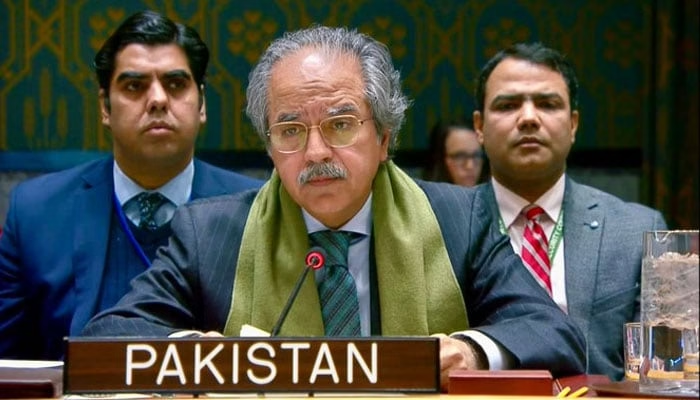
Pakistan calls for respect for international law at a time when global stability is under increasing strain and multilateral norms are being tested. Speaking at a high-level debate of the United Nations Security Council on January 26, Pakistan’s Permanent Representative to the UN, Ambassador Asim Iftikhar Ahmad, delivered a strong message: selective application of international law is eroding trust between states and fueling conflicts around the world.
In his address, the ambassador emphasized that international law exists to make relations between countries predictable, stable, and fair. When agreed rules are ignored or applied only when convenient, he warned, the very meaning of law is undermined. According to him, this erosion is not theoretical—it is directly contributing to armed conflicts, humanitarian crises, and weakening confidence in the global system.
Rule of Law Under Pressure
Ambassador Ahmad highlighted that core principles of the UN Charter, such as state sovereignty, territorial integrity, and the prohibition on the use of force, are being challenged with increasing frequency. He cautioned against the normalization of unilateral actions taken outside the UN framework, arguing that such behavior weakens multilateralism and encourages instability.
When Pakistan calls for respect for international law, it does so from the perspective of lived experience. The envoy noted that Pakistan has faced violations of international law firsthand, particularly in the context of regional tensions in South Asia. He referred to military aggression by India last year, stating that Pakistan’s response was carried out in self-defense under Article 51 of the UN Charter.
South Asia and the Kashmir Dispute
Addressing regional peace, Ambassador Ahmad stressed that lasting stability in South Asia cannot be achieved without resolving the Kashmir dispute in accordance with United Nations resolutions. He also emphasized the importance of honoring treaty obligations, including long-standing water-sharing agreements, warning that undermining such treaties sets a dangerous precedent.
His remarks reflected Pakistan’s broader position that disputes should be settled through dialogue, international law, and established multilateral mechanisms rather than force or unilateral actions.
Double Standards and the Global South
Expanding the discussion to the global level, the ambassador pointed out that many developing countries have long suffered from what he described as “double standards” in the international system. Despite these challenges, he said, countries of the Global South continue to place their trust in the United Nations and in a rules-based international order that treats all states equally.
This perspective reinforces why Pakistan calls for respect for international law not as a political slogan, but as a necessity for global fairness. Without equal application of rules, smaller and developing nations are often left vulnerable to the actions of more powerful states.
Positive Legal Developments
While his speech carried a strong warning, it also acknowledged progress in certain areas. Ambassador Ahmad pointed to advancements in international maritime law and recent advisory opinions issued by the International Court of Justice on matters related to Palestine and climate change. He welcomed these developments but stressed that legal rulings must be respected universally, not selectively.
He noted that the situation in Palestine serves as a stark example of what happens when international law is applied unevenly. Denying people their right to self-determination and ignoring UN resolutions, he argued, damages the credibility of the entire international system.
Strengthening Compliance with International Law
To address these challenges, Pakistan proposed several practical steps. These included improved monitoring of how Security Council resolutions are implemented, more frequent legal briefings to the Council, and greater reliance on the International Court of Justice for the peaceful resolution of disputes.
Ambassador Ahmad made it clear that defending the rule of law requires more than statements or symbolic commitments. Real action, accountability, and consistency are essential if multilateralism is to survive in an increasingly divided world.
Law Over Force
The core message of the speech was simple yet powerful: law must prevail over force, and justice over impunity. When Pakistan calls for respect for international law, it is advocating for a system where power does not override principles and where all nations regardless of size or influence—are held to the same standards.
The ambassador reaffirmed Pakistan’s commitment to peaceful dispute resolution and to a UN-centered international order. He stressed that only by honoring obligations, respecting legal norms, and applying rules equally can the United Nations truly serve as a guarantor of peace, justice, and dignity for all.
As global tensions continue to rise, Pakistan’s message at the Security Council serves as a reminder that the strength of the international system depends not on selective enforcement, but on universal respect for the rule of law.