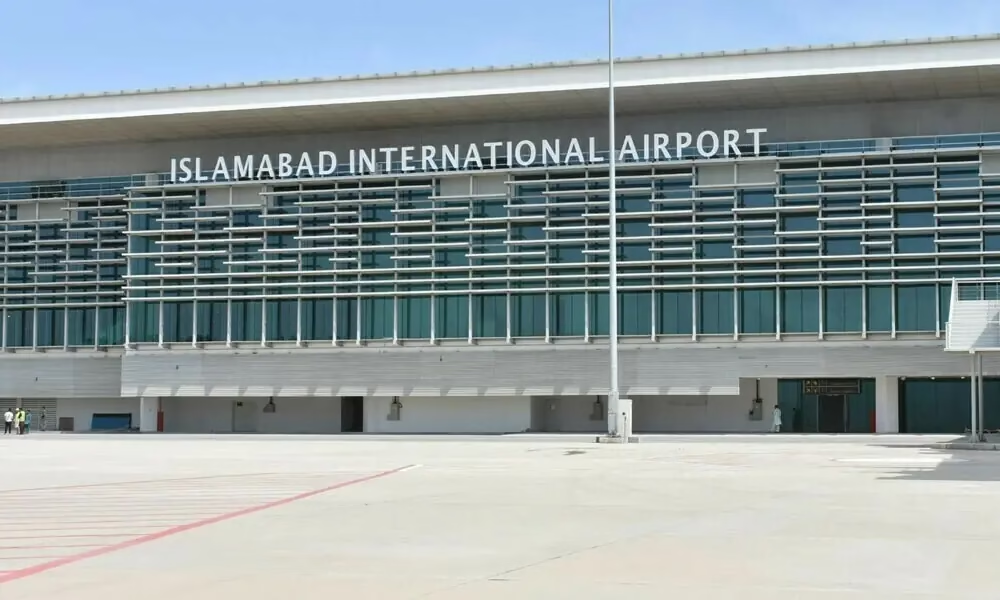
Pakistan airport privatisation has once again come into focus after the Privatisation Commission (PC) firmly rejected media reports claiming that Pakistan had cancelled a proposed lease of Islamabad International Airport to the United Arab Emirates (UAE). The commission clarified that these reports were misleading and factually incorrect, stressing that no lease or agreement had ever been signed with the UAE or any other country for the management of Pakistan’s airports.
Clearing the Confusion Around Islamabad Airport
The clarification came in response to news suggesting that the government had shelved plans to outsource the management and operations of Islamabad International Airport after alleged disinterest from Abu Dhabi. The Privatisation Commission categorically denied these claims, stating that there was never any finalized deal to cancel in the first place.
According to the PC, Islamabad International Airport is part of an ongoing and transparent privatisation process, similar to Karachi’s Jinnah International Airport and Lahore’s Allama Iqbal International Airport. These airports are included in the government’s active privatisation programme, which aims to explore multiple models such as management contracts and long-term commercial concessions.
This clarification is important because Pakistan airport privatisation has often been surrounded by speculation, partly due to the strategic and economic importance of the aviation sector.
Government’s Broader Privatisation Strategy
The Privatisation Commission explained that the government has been evaluating a range of options to modernise airport operations. The primary objectives behind outsourcing airport management include improving efficiency, enhancing passenger services, upgrading infrastructure, and maximising revenue generation.
Pakistan’s aviation sector has long faced challenges such as outdated facilities, operational inefficiencies, and financial losses. By pursuing Pakistan airport privatisation, the government hopes to attract private sector expertise and investment—both domestic and international—to address these issues in a sustainable way.
The PC also emphasized that discussions with international partners are a normal part of this process. Pakistan has held constructive dialogues with entities from the UAE, Turkey, Saudi Arabia, and other countries. However, these discussions should not be confused with signed agreements or binding commitments.
No UAE Deal Was Ever Signed
One of the strongest points in the commission’s statement was the clear rejection of claims that a lease agreement with the UAE had been cancelled. The PC stated unequivocally that no such agreement was ever signed for Islamabad International Airport or any other airport in the country.
By addressing this directly, the commission aimed to counter misinformation that could damage investor confidence. In large-scale reforms like Pakistan airport privatisation, clarity and transparency are essential to maintaining credibility with both the public and potential investors.
Shift to Open Bidding Process
A key development highlighted by the Privatisation Commission was the government’s decision in November 2025 to shift from a government-to-government (G2G) approach to an open and competitive bidding process for all three major airports.
This decision was made due to strong interest from a wide range of investors. Under the open bidding model, all qualified domestic and foreign investors will be given a level playing field. The PC stressed that this move was based purely on economic and procedural considerations, not political or diplomatic factors.
The open bidding approach aligns with international best practices and is expected to improve transparency, competition, and overall outcomes. For Pakistan airport privatisation, this step could help secure better financial terms and stronger operational partners.
Focus on Transparency and Fair Competition
The commission reiterated that the upcoming outsourcing process would prioritise inclusivity and fairness. Investors from partner countries, as well as local and international firms, will be equally eligible to participate.
This approach is designed to ensure that Pakistan gets the best possible value while strengthening long-term relationships with global partners. Transparent processes and fair competition are especially important in sectors like aviation, where public interest and national infrastructure are closely linked.
Why This Matters for Pakistan’s Economy
Airport operations play a critical role in trade, tourism, and foreign investment. Efficiently managed airports can significantly improve passenger experience, reduce operational costs, and boost non-aeronautical revenues. Through Pakistan airport privatisation, the government aims to modernise its aviation infrastructure without overburdening public finances.
While privatisation often sparks debate, the government maintains that private sector participation is necessary to turn around loss-making assets and improve service quality. The Privatisation Commission’s clarification suggests that Pakistan is proceeding cautiously, ensuring that decisions are made through structured and competitive processes.
The Privatisation Commission’s statement has put to rest rumours about the cancellation of a UAE lease for Islamabad International Airport. By confirming that no agreement ever existed and outlining the shift toward open bidding, the government has reinforced its commitment to transparency and economic reform.
As Pakistan airport privatisation moves forward, the focus will remain on attracting credible investors, improving airport services, and delivering long-term benefits to the national economy. Clear communication and consistent policy implementation will be key to ensuring the success of this ambitious reform agenda.