Pakistan Gaza Peace Board has become a major point of debate after the government defended its decision to join the US-led international forum aimed at ensuring lasting peace in Gaza. Federal Minister for Planning Ahsan Iqbal described the move as a diplomatic success, stressing that Pakistan’s core stance on Palestine remains unchanged despite criticism from opposition parties.
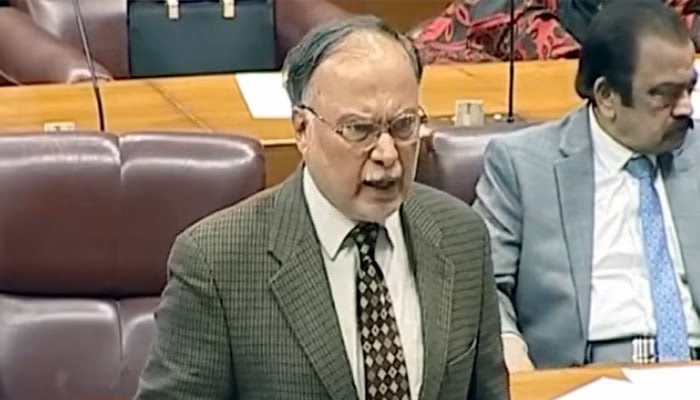
Speaking during a joint sitting of Parliament, Ahsan Iqbal rejected allegations that Pakistan acted out of weakness or negligence by joining the forum. He stated clearly that Pakistan does not need lessons from anyone on national security or foreign policy and that participation in the Pakistan Gaza Peace Board was a calculated diplomatic step taken in the national interest.
What Is the Gaza Peace Board?
The Gaza Peace Board was launched by US President Donald Trump on the sidelines of the World Economic Forum (WEF) annual meeting in Davos. Leaders and senior officials from 19 countries gathered to sign the founding charter, signaling their intent to work toward a lasting agreement for Gaza. Prime Minister Shehbaz Sharif represented Pakistan and signed on after receiving a formal invitation from President Trump.
According to the government, Pakistan’s inclusion in the Pakistan Gaza Peace Board provides an opportunity to raise concerns directly at a global platform rather than remaining on the sidelines while decisions are made without its input.
Government’s Justification
Ahsan Iqbal emphasized that Pakistan’s participation does not mean any shift in its principled position on Israel and Palestine. He reaffirmed that Pakistan continues to view Israel as an aggressor responsible for the killing of innocent Palestinians. The minister reiterated Pakistan’s long-standing support for the establishment of an independent Palestinian state based on pre-1967 borders, with Al-Quds Al-Sharif as its capital.
He argued that diplomacy sometimes requires engagement, even in difficult forums. According to him, had Pakistan refused to join the Pakistan Gaza Peace Board, the opposition would have accused the government of isolating the country internationally at a crucial moment.
Addressing Opposition Criticism
The decision sparked protests from opposition parties during the parliamentary session. Opposition Leader in the Senate, Allama Raja Nasir Abbas, questioned the government’s judgment and warned that what Israel had failed to achieve militarily might now be pursued under the banner of peace.
JUI-F chief Maulana Fazlur Rehman also criticized the move, accusing President Trump of strengthening Israeli aggression and threatening Hamas. He questioned Pakistan’s participation in a forum that, in his view, began with threats rather than genuine peace efforts. He further alleged that the prime minister did not take parliament or the cabinet into confidence before committing to the forum.
In response, Ahsan Iqbal maintained that Pakistan’s voice would be more effective from within the forum rather than outside it. He added that diplomacy often involves engaging with differing viewpoints to push forward one’s own principled stance.
Pakistan’s Role and Regional Context
The minister highlighted that the current ceasefire in Gaza was the result of coordinated efforts by eight Islamic countries, suggesting that international engagement can yield results when pursued strategically. He stressed that Pakistan joining the Pakistan Gaza Peace Board should be seen as part of a broader diplomatic effort to reduce violence and highlight Palestinian suffering on global platforms.
Iqbal argued that Pakistan’s presence in the forum allows it to counter narratives that may otherwise go unchallenged. By participating, Pakistan can directly advocate for Palestinian rights and resist any attempt to legitimize Israeli aggression under the guise of peace.
Diplomatic Risks and Opportunities
While critics fear that participation may be misused to whitewash Israeli actions, the government believes the benefits outweigh the risks. From Islamabad’s perspective, diplomacy is not endorsement but engagement. The Pakistan Gaza Peace Board, officials argue, is a forum where Pakistan can assert its moral and political position rather than surrendering the space to others.
The debate also reflects a broader tension in Pakistan’s foreign policy balancing public sentiment strongly in favor of Palestine with the realities of global diplomacy. The government insists that joining the board does not dilute Pakistan’s commitment but instead strengthens its ability to influence outcomes.
The controversy surrounding the Pakistan Gaza Peace Board underscores the sensitivity of the Palestinian issue within Pakistan’s political landscape. While opposition parties view the move with suspicion, the government presents it as a strategic diplomatic success aimed at protecting Palestinian interests at a critical time.
As regional and global dynamics continue to evolve, Pakistan’s decision will be judged by its outcomes rather than intentions. For now, the government remains firm that engagement, not isolation, offers the best chance to advocate for justice, peace, and an independent Palestinian state.