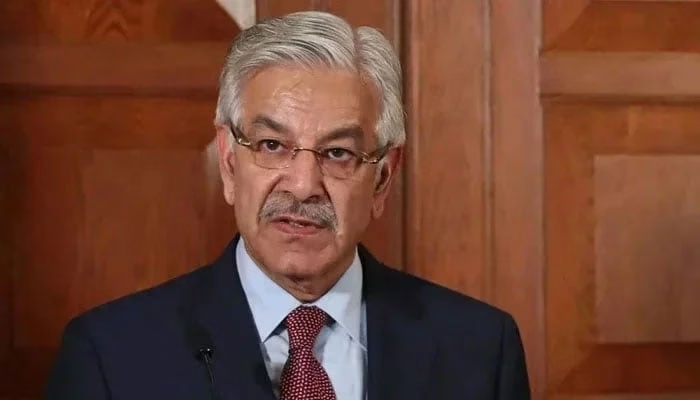
The debate around 18th Amendment implementation has resurfaced after Defence Minister Khawaja Asif openly blamed lawmakers themselves for turning a landmark constitutional reform into what he called a hollow slogan.His remarks have sparked a wider discussion about devolution of power, local governance, and why ordinary citizens have yet to see the promised benefits of the amendment more than a decade after its passage.
What the 18th Amendment Promised
The core idea behind the 18th Amendment implementation was simple but powerful: decentralise authority and bring governance closer to the people. By transferring powers from the centre to the provinces and further down to local governments, the amendment aimed to strengthen democracy at the grassroots level. In theory, this would allow citizens to directly influence decisions affecting their daily lives, from sanitation and water supply to education and healthcare.
However, Khawaja Asif argues that this vision was never realised in practice. Speaking on a television programme, he questioned whether power had genuinely moved to lower tiers of government anywhere in the country. According to him, provinces largely absorbed authority themselves, leaving local governments weak or non-functional.
Lawmakers and Political Will
A key point in Asif’s criticism is the lack of political sincerity. He placed responsibility for failed 18th Amendment implementation squarely on the shoulders of politicians who passed the amendment but did not follow through. Successive civilian governments, he said, avoided empowering local bodies, often delaying or deferring local government elections on various pretexts.
This reluctance, Asif suggested, stems from a fear of losing control. Strong local governments mean sharing power, resources, and influence—something many provincial leaders have been unwilling to do. As a result, the amendment’s promise of devolution stopped at the provincial level instead of reaching cities, towns, and villages.
Why Local Governments Matter
In his public statements, Asif stressed that effective local governments are essential for a country with a population exceeding 250 million. Cities like Karachi, Lahore, Quetta, and Peshawar require empowered municipal systems to manage complex urban challenges. Without functional local bodies, citizens are forced to rely on distant provincial departments or unelected bureaucrats.
The defence minister highlighted that under true 18th Amendment implementation, citizens would elect their own local representatives and institutions. These representatives, unlike bureaucrats with temporary postings, could be directly held accountable through the ballot box if they failed to deliver.
Services That Should Be Local
Asif outlined a broad range of civic services that should fall under local governments. These include water supply, sanitation, fire brigade services, drainage, primary education, basic healthcare, local roads, and management of encroachments. He also argued for an independent local taxation system, which would give municipalities the financial autonomy needed to function effectively.
By keeping these services close to the community, governance becomes more responsive. Problems can be addressed faster, priorities set according to local needs, and public trust strengthened—key goals of the 18th Amendment implementation that remain unmet.
Lessons from Global Models
Citing international examples, Asif noted that in many countries, elements of policing and even parts of the judicial system operate under elected local authorities. These systems demonstrate how decentralisation can improve service delivery and reduce public frustration.
In contrast, weak and powerless local bodies, he warned, do more harm than good. When local institutions exist only on paper, they fail to deliver services and create political backlash. This undermines democracy rather than strengthening it.
Dictatorship vs Civilian Rule Paradox
One of Asif’s most striking observations was that empowered local bodies were historically introduced under military rulers, not civilian governments. He described this as a paradox of Pakistan’s political history. While dictators established strong municipal systems, democratic governments often rolled them back or left them ineffective.
This reality, he argued, exposes a fundamental contradiction: while democracy champions representation, its leaders have repeatedly resisted true decentralisation, weakening the spirit of the 18th Amendment implementation.
Concentration vs Dispersal of Power
Asif concluded with a broader principle: concentration of power diminishes its effectiveness, while dispersal multiplies it. Strong local governments reduce unrest, bring administration closer to the people, and create a durable bond between the state and citizens. A satisfied society, he said, ultimately leads to a stronger country.
The renewed focus on 18th Amendment implementation highlights an uncomfortable truth. Constitutional changes alone are not enough; political will is essential. Until local governments are genuinely empowered, the amendment will remain an unfulfilled promise. Khawaja Asif’s comments serve as a reminder that real reform begins not with slogans, but with the courage to share power where it matters most—at the grassroots level.