The Harry Brook controversy has become more than a story about a late-night incident; it has evolved into a mirror reflecting deeper issues within England’s cricket leadership and team culture. What began as an off-field mis demeanour in Wellington has now resurfaced thousands of miles away, forcing uncomfortable questions about accountability, discipline, and the direction of English cricket.
At its core, the Harry Brook controversy stems from an incident on the eve of an England one-day international in New Zealand, when Brook was involved in a clash with a nightclub bouncer. While the event itself occurred before England even set foot in Australia, its consequences rippled through a disastrous Ashes series and continue to shape the narrative around England’s white-ball and Test teams.
Timing and Accountability
Brook, now England’s white-ball captain and Test vice-captain, found himself answering questions in Colombo ahead of another ODI. On one level, this is entirely fair. Leaders are expected to front up, and past England captains have dealt with far more serious controversies. The Harry Brook controversy, while embarrassing, is not career-defining in isolation.
Yet what has raised eyebrows is not just Brook’s actions, but the silence from the England and Wales Cricket Board (ECB). The incident only became public after a media report at the end of the Ashes, prompting questions about whether it would have been addressed at all had it not leaked.
A Culture of Silence
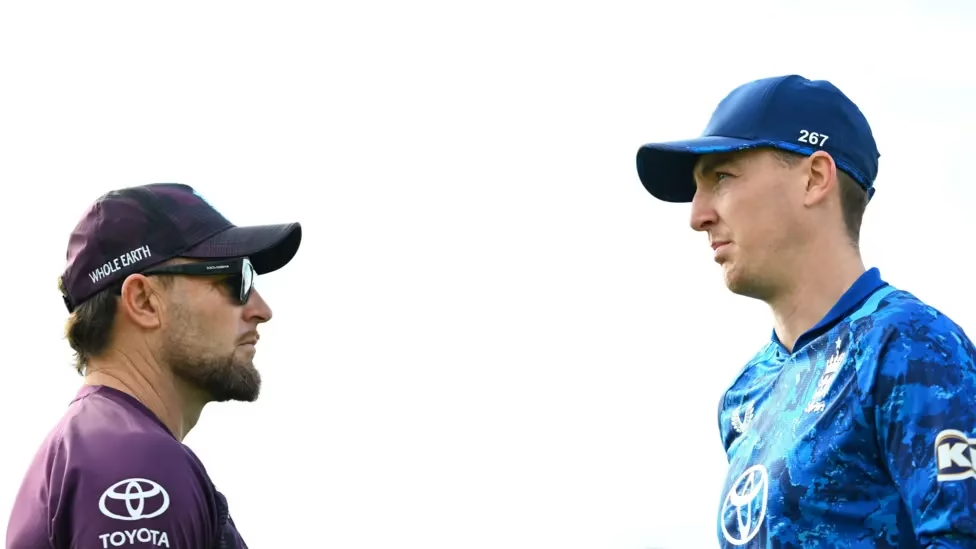
The ECB hierarchy has largely avoided public scrutiny over the issue. Chief executive Richard Gould spoke of an Ashes “review” before the story broke. Head coach Brendon McCullum downplayed off-field behaviour, saying players are allowed “a couple of beers now and again.” Director of cricket Rob Key last spoke on the matter weeks earlier, referencing a separate warning issued to Brook and Jacob Bethell on the same night.
This attempt to keep the matter quiet has arguably damaged trust. The Harry Brook controversy now feels less like an isolated lapse and more like evidence of a system reluctant to confront uncomfortable truths.
Freedom vs Discipline
Under McCullum, England embraced a player-empowerment philosophy. From allowing bacon sandwiches to encouraging freedom off the field, the approach was designed to create relaxed, confident cricketers. Initially, it worked — particularly in Test cricket.
However, the Ashes collapse exposed the limits of that freedom. Dropped catches, poor shot selection, and lacklustre discipline painted a picture of a team struggling to balance enjoyment with responsibility. The Harry Brook controversy fits neatly into this wider pattern.
The introduction of a midnight curfew in Sri Lanka signals a shift. But critics ask why this change came only after the incident became public. England’s management knew about Brook’s behaviour months earlier, yet players were still allowed considerable off-field freedom during the Ashes, including social trips in Australia.
Structural Changes Begin
In response, subtle but significant changes are emerging. The short-term return of Carl Hopkinson as a fielding coach highlights renewed emphasis on basics. Troy Cooley’s planned role as national pace-bowling lead suggests technical tightening. Even assistant coaches may come under review.
These moves indicate that the Harry Brook controversy has accelerated broader reforms already under consideration after the Ashes debacle.
McCullum’s Crossroads
Ultimately, the spotlight falls on Brendon McCullum. Contracted until the 2027 World Cup, he has openly said he is willing to evolve — but only if he retains the ability to steer the ship.The question now is whether imposed discipline undermines his philosophy or strengthens it.
McCullum’s past mantra if you can’t change a man, change the man has guided tough selection calls. Now, he must apply that thinking to leadership style itself. Can freedom and discipline coexist, or must one give way?
Brook’s Place in the Future
Despite the Harry Brook controversy, Brook remains central to England’s plans. He has played more matches than any England cricketer since his 2022 Test debut, turned down lucrative franchise deals, and is widely seen as a future Test captain. His public apology and praise of McCullum as the best coach he has played for underline his commitment.
That loyalty, however, may be part of the problem. McCullum’s popularity with players stems from the freedoms he offers — freedoms now under scrutiny as results falter.
The Harry Brook controversy is not about one night out. It is about leadership, transparency, and the fine line between empowerment and excess. As England prepare for crucial series and eye qualification for the 2027 World Cup, success on the field may ease tensions. But regardless of results, English cricket must decide what kind of culture it wants — and whether its leaders are willing to enforce it consistently.