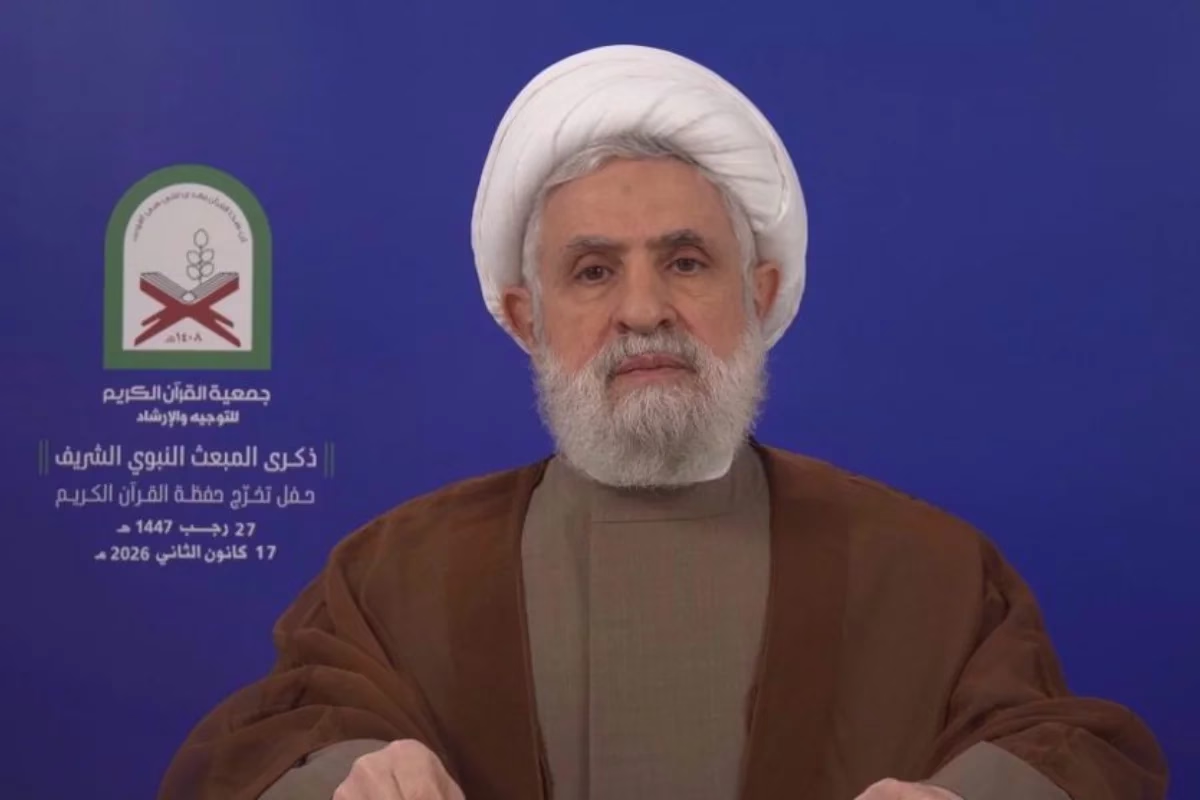
Hezbollah statement on Iran unrest has drawn regional attention after the group’s deputy secretary general, Sheikh Naim Qassem, publicly praised Iran and accused the United States and Israel of orchestrating recent riots to destabilize the country. His remarks, delivered during a televised address from Beirut, framed Iran as a symbol of resistance, independence, and freedom in the Middle East.
Speaking on the occasion of Eid al-Mab’ath, Sheikh Qassem said that the unrest in Iran was not spontaneous but part of a deliberate plan. According to him, US President Donald Trump and Israeli Prime Minister Benjamin Netanyahu encouraged and incited unrest with the aim of overthrowing Iran’s Islamic establishment and reshaping the regional balance of power to suit their interests.
Accusations Against the US and Israel
In his address, Sheikh Qassem claimed that Washington and Tel Aviv failed to achieve their objectives because of the strong response from the Iranian public. He said millions of Iranians came out in support of the state, countering what he described as small groups of rioters. The Hezbollah statement on Iran unrest emphasized that mass rallies reflected the true will of the people, while isolated acts of violence could not represent national sentiment.
He argued that decades of sanctions and what he called the “maximum pressure” campaign had failed to weaken Iran. As a result, he claimed, the United States shifted tactics toward encouraging unrest and instability inside the country.
Iran as a Symbol of Resistance
A key theme of the Hezbollah statement on Iran unrest was the portrayal of Iran as a resilient nation that has withstood economic, political, and security pressure. Sheikh Qassem described Iran as a “fortress of resistance” that continues to inspire oppressed people across the region.
He credited the Iranian leadership, particularly Supreme Leader Ayatollah Seyyed Ali Khamenei, for guiding the country through difficult times. According to him, strong leadership combined with public resistance and the actions of state institutions prevented what he described as a foreign-backed attempt to undermine Iran’s sovereignty.
Criticism of US Regional Policy
Sheikh Qassem also criticized broader US policy in the Middle East, claiming that Washington does not support genuine freedom or self-governance. Instead, he alleged that the United States seeks to influence nations’ decisions and supports Israeli expansionism in the region.
Within the Hezbollah statement on Iran unrest, he argued that Iran’s political system represents an independent model that challenges US dominance. This independence, he said, is the real reason Iran remains under constant pressure.
Public Support as a Decisive Factor
A significant part of Sheikh Qassem’s remarks focused on public mobilization in Iran. He said the scale of pro-establishment demonstrations showed that the majority of Iranians rejected unrest and foreign interference. According to him, the contrast between millions of demonstrators and small groups of protesters revealed where public opinion truly stood.
The Hezbollah statement on Iran unrest framed this public response as a decisive factor that thwarted what he described as a coordinated plan to destabilize the country. He maintained that popular resistance remains Iran’s strongest defense against external pressure.
Regional Implications
Analysts say such statements reflect broader regional dynamics, where Iran and its allies present themselves as part of a resistance axis opposing US and Israeli influence. The Hezbollah statement on Iran unrest reinforces this narrative, portraying Iran not only as a nation defending itself but also as a source of inspiration for movements across the region.
Supporters of this view argue that Iran’s endurance despite sanctions has strengthened its standing among allied groups. Critics, however, see such rhetoric as deepening regional polarization and escalating tensions.
The Hezbollah statement on Iran unrest highlights how internal developments in Iran are interpreted through a wider geopolitical lens. By accusing the US and Israel of planning unrest and praising Iran’s resilience, Sheikh Naim Qassem reinforced Hezbollah’s alignment with Tehran and its broader resistance narrative.
Whether one agrees with this perspective or not, the speech underscores the symbolic importance Iran holds for allied movements in the region. For them, Iran represents steadfastness under pressure, while for its critics, it remains a central point of contention in Middle Eastern politics.