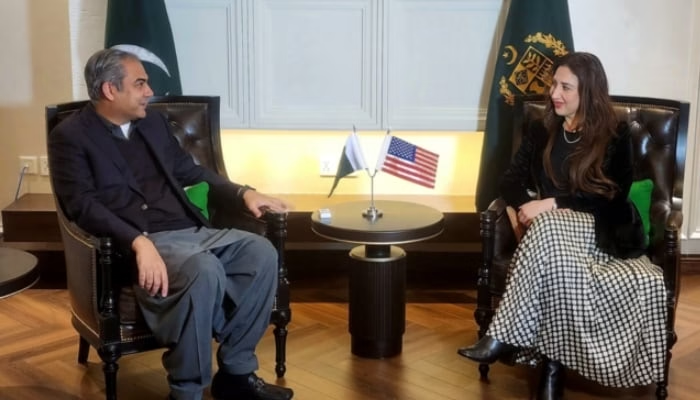
Pakistan and the United States have agreed to deepen Pakistan-US security cooperation as both countries look to strengthen collaboration on border management, counterterrorism, and crime prevention. The understanding was reached during a high-level meeting in Islamabad between Interior Minister Mohsin Naqvi and a US delegation led by Chargé d’Affaires Natalie Baker, reflecting renewed momentum in bilateral relations.
In the first phase of discussions, both sides focused on shared security challenges and the need for modern solutions. The agreement highlights how Pakistan-US security cooperation continues to evolve beyond traditional frameworks, now emphasizing technology, training, and institutional capacity-building.
High-Level Meeting in Islamabad
The meeting brought together senior officials from Pakistan’s key security and law enforcement institutions. Alongside Interior Minister Mohsin Naqvi, the session was attended by Minister of State for Interior Talal Chaudhry, director generals of the Federal Investigation Agency (FIA) and the National Cyber Crimes Investigation Agency (NCCIA), the Federal Constabulary (FC) commandant, and other high-ranking officials.
From the US side, Natalie Baker led a delegation that reaffirmed Washington’s interest in expanding engagement with Pakistan in areas of mutual concern. The talks underscored that Pakistan-US security cooperation is not limited to policy dialogue but extends to practical steps on the ground.
Focus on Border Management and Technology
A key area of discussion was border security and management. Interior Minister Naqvi said Pakistan plans to utilise advanced software and modern technology to identify individuals involved in crimes abroad. This initiative aims to improve information-sharing and help law enforcement agencies track transnational criminal networks more effectively.
He added that modern tools would also enhance the operational capacity of border security agencies and coastal guards. Strengthening these institutions is seen as critical to tackling issues such as illegal migration, smuggling, and cross-border crime. In this context, Pakistan-US security cooperation is expected to play a vital role by providing technical assistance and expertise.
Expanding Counterterrorism and Law Enforcement Cooperation
Both sides agreed to further strengthen cooperation under existing frameworks, including the Anti-Terrorist Assistance Programme and the Bureau of International Narcotics and Law Enforcement Affairs. These platforms have long supported Pakistan’s efforts in counterterrorism, policing, and judicial reform.
During the meeting, the US delegation discussed training programmes for officers from the FIA, FC, and NCCIA. Capacity-building through specialised training is a cornerstone of Pakistan-US security cooperation, enabling Pakistani institutions to adopt international best practices in investigation, intelligence, and cybercrime prevention.
New Institutions and US Support
Another major development discussed was the proposed establishment of a Centre for Transformation Crime and a dedicated academy within the FIA, with US support. These initiatives aim to modernise Pakistan’s investigative framework and prepare law enforcement agencies to deal with emerging threats, including cybercrime and financial fraud.
Minister Naqvi welcomed US assistance in reorganising the Federal Constabulary and strengthening the capabilities of the FIA and NCCIA. He noted that US support in activating the FIA’s Counter-Terrorism Wing would be particularly valuable, as it would become the first federal anti-terrorist wing with effective coordination across provinces.
Combating Cybercrime and Financial Fraud
Cybercrime and financial fraud were also key topics in the discussions. The interior minister highlighted NCCIA’s extensive crackdown on illegal call centres across Pakistan, stressing that advanced software is essential to prevent financial fraud and terror financing.
He praised existing US cooperation with NCCIA in this area and called for further expansion of collaboration. As cyber threats grow more sophisticated, Pakistan-US security cooperation in digital investigations and cyber forensics is increasingly important for protecting both national and international financial systems.
Equipment and Modernisation
The meeting also covered plans to equip border security agencies, coastal guards, and other institutions with modern US-supplied equipment. Such upgrades are intended to improve surveillance, communication, and rapid response capabilities.
These measures reflect a broader approach to Pakistan-US security cooperation that combines training, technology, and infrastructure support to strengthen law enforcement effectiveness.
US Response and Future Outlook
The US delegation appreciated Pakistan’s efforts to enhance security cooperation and reinforce bilateral ties. Natalie Baker acknowledged the ongoing collaboration between Pakistan’s interior ministry and US agencies at multiple levels and reaffirmed Washington’s commitment to further strengthening these partnerships.
She noted that sustained engagement and trust-building are essential for addressing shared challenges, from terrorism and organised crime to cyber threats.
Strengthening a Strategic Partnership
The meeting signaled a positive step forward in Pakistan-US security cooperation. By focusing on practical initiatives such as technology transfer, training, and institutional reform, both countries aim to build a more resilient security partnership.
As regional and global security challenges continue to evolve, this renewed commitment highlights the importance of cooperation based on mutual interests, shared responsibility, and long-term stability.