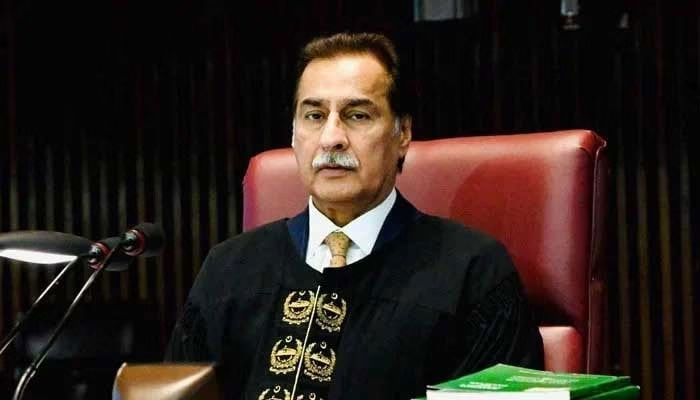
The recent NA Speaker remarks by Sardar Ayaz Sadiq have sparked wide discussion about parliamentary discipline, freedom of expression, and constitutional boundaries in Pakistan’s National Assembly. Speaking during a visit to the National College of Arts (NCA) in Lahore, the Speaker made it clear that statements against Pakistan, the judiciary, or the armed forces would not be permitted on the floor of the House, emphasizing the need to uphold constitutional limits and national unity.
In his comments to journalists, the NA Speaker remarks highlighted the sensitive balance between democratic debate and institutional respect. Sadiq stressed that criticism crossing constitutional and legal lines would not be tolerated, particularly when it targets state institutions responsible for national security and governance.
Upholding Constitutional Boundaries
Sardar Ayaz Sadiq underlined that parliamentary discussions must strictly remain within the framework defined by the Constitution and the rules of procedure of the National Assembly. According to the NA Speaker remarks, freedom of speech in Parliament does not extend to statements that undermine Pakistan’s integrity or question the credibility of its core institutions.
He categorically stated that anyone speaking against Pakistan would not be allowed to express such views in the House. This position, he explained, is not driven by political alignment but by his constitutional role as Speaker, which requires neutrality and adherence to parliamentary rules.
Neutral Role of the Speaker
One of the key points in the NA Speaker remarks was Sadiq’s emphasis on impartiality. He clarified that he is neither part of the government nor the opposition. As Speaker, his duty is to conduct proceedings fairly and ensure that all members follow established rules.
By reinforcing this stance, Sadiq sought to counter perceptions that his decisions might favor one side of the political aisle. He reiterated that his actions are guided solely by constitutional obligations, not by political considerations.
Protest as a Democratic Right
While drawing firm lines on parliamentary speech, the NA Speaker remarks also acknowledged the importance of democratic protest. Sadiq affirmed that protest is a fundamental right of every citizen in a democratic system. However, he strongly stressed that protests must remain peaceful.
He warned that there is no room for arson, vandalism, or damage to life and property. According to him, the use of sticks, weapons, or violent tactics is alarming and poses a serious threat to the rule of law. Such actions, he said, undermine democratic values rather than strengthening them.
Rule of Law and Public Responsibility
Another important theme in the NA Speaker remarks was shared responsibility. Sadiq noted that every country faces challenges from illegal elements, and combating them is not solely the state’s job. The public also has a role to play in maintaining order and steering the country toward development and prosperity.
By emphasizing collective responsibility, the Speaker framed law and order as a national concern rather than a political issue, urging cooperation between citizens and institutions.
Relationship with the Prime Minister
Addressing questions about his working relationship with the government, Sadiq said he holds regular consultations with Prime Minister Shehbaz Sharif. However, he was quick to add that the prime minister has never restrained him from exercising his constitutional authority.
This clarification in the NA Speaker remarks was aimed at reinforcing the independence of the Speaker’s office and dispelling any notion of external pressure influencing parliamentary decisions.
Economic Stability and Foreign Relations
Beyond parliamentary conduct, Sadiq also touched on broader national issues. He observed that Pakistan’s economy is gradually strengthening, calling it clear evidence of improving economic stability. While acknowledging ongoing challenges, he expressed optimism about the country’s financial direction.
The NA Speaker remarks also highlighted Pakistan’s foreign relations. Sadiq noted that Pakistan enjoys cordial and strong ties with key countries, including the United States, China, Russia, Türkiye, and Saudi Arabia. These relationships, he suggested, are important for economic growth and regional stability.
Praise for National College of Arts
During his visit, Sadiq praised the National College of Arts as a prestigious institution that has earned recognition at both national and international levels. He appreciated the research-based creative work of NCA students and described the youth studying there as a valuable national asset.
According to him, the success of young Pakistanis in diverse fields reflects the country’s potential and underscores the importance of investing in education and creativity.
A Message of Discipline and Unity
The NA Speaker remarks convey a clear message: democratic debate must be conducted responsibly, with respect for constitutional limits and national institutions. While freedom of expression remains a cornerstone of democracy, Sadiq emphasized that it cannot come at the cost of national integrity, public safety, or the rule of law.
As political temperatures remain high, these remarks set a firm tone for parliamentary conduct, highlighting discipline, neutrality, and unity as essential elements for Pakistan’s democratic and institutional stability.