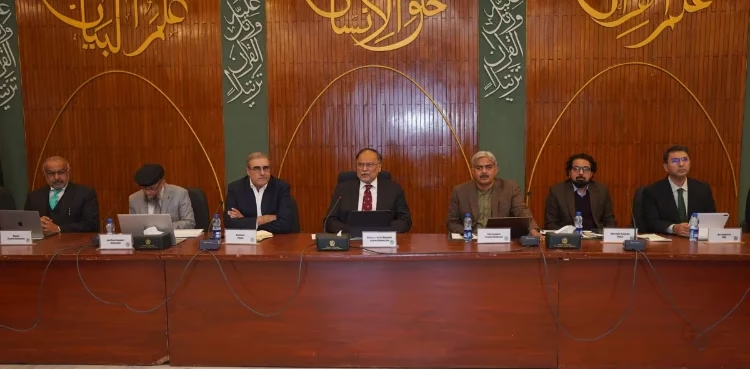
Federal Minister for Planning, Development and Special Initiatives and Deputy Chairman Planning Commission, Ahsan Iqbal, on Thursday approved five major health-sector projects under the Uraan Pakistan social sector drive while chairing a meeting of the Central Development Working Party (CDWP).
Of the five projects, three schemes with a combined cost of Rs12.524 billion were approved by the CDWP, while two larger projects worth Rs56.823 billion were referred to the Executive Committee of the National Economic Council (ECNEC) for final approval. Federal Minister for National Health Services, Regulation and Coordination Mustafa Kamal attended the meeting to present and justify the proposals of his ministry.
One of the most significant initiatives reviewed was a revised version of the Sehat Sahulat Program, approved at a cost of Rs40.188 billion and forwarded to ECNEC. The programme, part of the government’s Social Health Protection Initiative, aims to provide inpatient health insurance coverage to all permanent resident families in Islamabad, Azad Jammu and Kashmir, and Gilgit-Baltistan, based on national identity records.
Officials said the scheme is designed to reduce out-of-pocket healthcare expenses and catastrophic hospitalisation costs by up to 60 per cent, particularly for low-income and vulnerable households. Under the revised framework, the programme will be implemented through the development budget on a universal basis in the Islamabad Capital Territory, AJK and Gilgit-Baltistan to improve overall public health outcomes.
Ahsan Iqbal noted that the Sehat Sahulat Program would be restored to its original focus on underprivileged and deserving families, saying its expansion in recent years had stretched resources and reduced access for those most in need. The programme was initially launched in 2015 as the Prime Minister National Health Program.
The CDWP also approved a revised project titled “Establishment of Jinnah Hospital (Polyclinic/PGMI-II) at G-11/3, Islamabad,” at a total cost of Rs15.948 billion, recommending it to ECNEC for final approval. Under the revised scope, the hospital’s bed capacity has been increased from 311 to 400 and will include modern IT systems, biomedical equipment, solar power solutions, and HVAC operation and maintenance facilities. The project is now expected to be completed by June 2027.
While reviewing the hospital project, Ahsan Iqbal expressed concern over cost escalation and called for more rigorous planning and realistic costing at the proposal stage. He also directed that a mosque be included within the approved budget.
Two additional revised projects were approved by the forum, including the “Development of Integrated Disease Surveillance and Response System (IDSRS) with Public Health Laboratories Network (PHLN) and Workforce Development for Transition of Field Epidemiology Training & Laboratory Program (FELTP)” at a cost of Rs7.484 billion, and “Strengthening Points of Entry and Border Health Services Pakistan, Karachi (formerly Directorate of Central Health Establishments)” worth Rs2.864 billion.
Another project costing Rs2.174 billion was approved to upgrade cardiology and other departments at the Federal Government Polyclinic Hospital in Islamabad.
Ahsan Iqbal emphasised that government investment in health infrastructure must ensure immediate operational readiness upon completion, warning that delays in functionality undermine the objective of providing timely services to the poor.
During deliberations on the IDSRS project, he also made it clear that the approval constituted the final revision and that no further revisions would be entertained by the forum.