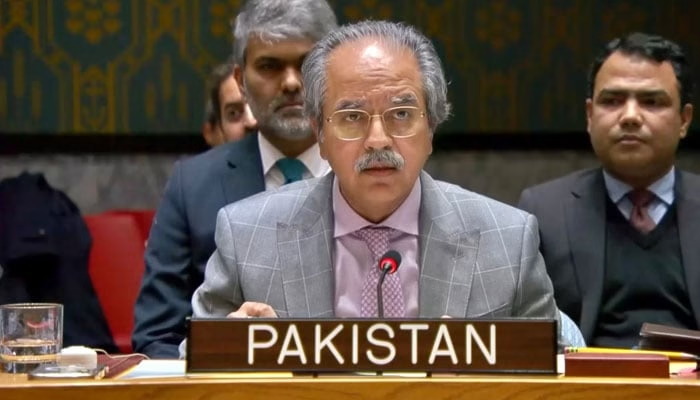
Pakistan urges diplomacy on Iran tensions as Islamabad has called for calm, restraint, and dialogue amid rising regional uncertainty. Speaking at a United Nations Security Council session on the situation in the Middle East, Pakistan made it clear that threats or the use of force against Iran would only worsen instability and deepen humanitarian suffering. The message reflects Pakistan’s consistent position that disputes must be resolved peacefully and in accordance with international law.
Addressing the Security Council, Pakistan’s Permanent Representative to the UN, Ambassador Asim Iftikhar Ahmad, warned that continued hostilities and unilateral actions are pushing the region further away from stability. He stressed that coercive measures and military threats do not offer solutions but instead create long-term consequences for peace and security. According to him, the current trajectory of tensions risks inflaming an already fragile regional environment.
Pakistan urges diplomacy on Iran tensions at a time when rhetoric surrounding possible action against Tehran has intensified. Ambassador Ahmad noted that Islamabad is closely monitoring developments in Iran and the wider region, describing the emerging threats as a serious concern. He cautioned that escalation would not only affect Iran but could also have ripple effects across neighbouring countries and beyond.
A key part of Pakistan’s statement focused on its close relationship with Iran. Calling Iran an immediate neighbour and a “brotherly country,” the envoy highlighted the deep historical, cultural, and religious ties shared by the two nations. He emphasised that a stable and peaceful Iran is in the interest of Pakistan, the region, and the international community as a whole. This regional perspective underlines why Pakistan urges diplomacy on Iran tensions rather than confrontation.
Ambassador Ahmad also expressed confidence in the Iranian people and leadership, noting their long history, resilience, and rich civilisation. He said Pakistan hopes for an early normalisation of the situation in Iran and supports all diplomatic efforts aimed at restoring calm. In his view, internal challenges should be addressed through dialogue and lawful means, without external interference.
International law and the principles of the UN Charter were central to Pakistan’s remarks. The envoy reminded the Security Council that the threat or use of force against the territorial integrity or political independence of any state is clearly prohibited. He added that external interference in domestic affairs undermines international norms and weakens the global order. Pakistan’s stance reinforces its long-standing advocacy for multilateralism and respect for sovereignty.
Islamabad’s call for restraint comes against the backdrop of new sanctions imposed by the United States on Iranian officials accused of orchestrating a crackdown on protests. Washington has also signalled that it is tracking Iranian leaders’ financial activities abroad. These developments have added another layer of tension to an already volatile situation, raising fears of further escalation.
The unrest in Iran began with protests over rising prices and economic hardship before evolving into one of the most serious challenges to the country’s leadership in decades. While the United States has voiced support for protesters and increased pressure on Tehran, Pakistan has taken a more cautious approach. Pakistan urges diplomacy on Iran tensions because it believes punitive measures and threats of intervention risk aggravating humanitarian conditions and prolonging instability.
From Islamabad’s perspective, the Middle East is already burdened by prolonged conflicts, political divisions, and economic stress. Adding another flashpoint through military confrontation would, Pakistan argues, only compound these challenges. Ambassador Ahmad urged all parties to exercise responsibility and avoid actions that could further damage regional and international security.
Diplomacy and dialogue, he said, must remain the guiding principles for resolving disputes. Pakistan has consistently supported engagement over confrontation, whether through bilateral talks, regional initiatives, or multilateral forums like the United Nations. This approach reflects a belief that sustainable peace can only be achieved when all sides are willing to negotiate in good faith.
Pakistan also hopes that all stakeholders will return to the negotiating table to seek solutions based on mutual respect and understanding. According to Islamabad, meaningful dialogue can help de-escalate tensions, address legitimate concerns, and prevent further suffering for civilians caught in the middle of geopolitical rivalries.
Pakistan urges diplomacy on Iran tensions as a path toward stability in a region already marked by uncertainty. By calling for restraint, respect for international law, and peaceful engagement, Islamabad is positioning itself as a voice for moderation. Whether global powers heed this call remains uncertain, but Pakistan’s message is clear: peace and dialogue, not force, offer the only viable way forward.