Gaza native and former Palestinian Authority deputy minister Ali Shaath has been appointed to head a new technocratic committee tasked with administering the war-ravaged Gaza Strip, mediating countries announced on Wednesday.
A seasoned civil servant with a low public profile, Shaath was born in Khan Yunis in southern Gaza in 1958 and later moved to Cairo for higher education, a family member told AFP. A civil engineer by profession, he has previously served as the Palestinian Authority’s deputy minister of planning and international cooperation, as well as undersecretary for the ministries of transportation and communications, among other roles.
Speaking in a detailed interview with Palestinian Basma Radio, Shaath outlined his vision for rebuilding Gaza, which has been devastated by more than two years of war and heavy bombardment. He stressed that the task ahead goes beyond reconstruction.
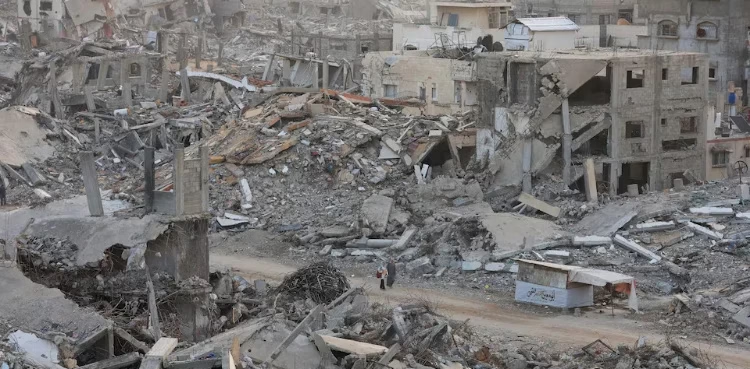
“We are not talking about ‘reconstruction’ but construction anew,” he said, underscoring the urgent need for shelter for Gaza’s 2.2 million residents, nearly all of whom have been displaced at least once during the conflict.
Shaath highlighted water infrastructure as a top priority, calling it essential for restoring basic services. “We will set plans for water supply, well rehabilitation, purification and treated water — water is the foundation of health, education and hospitals, all of which were destroyed,” he said.
Addressing the massive volume of rubble from destroyed buildings, Shaath suggested the possibility of disposing of it into the adjacent Mediterranean Sea to reclaim land.
He revealed that Bulgarian diplomat and politician Nickolay Mladenov had contacted him regarding the position. Under former US President Donald Trump’s Gaza peace plan, the technocratic committee would operate under the supervision of a so-called “Board of Peace”, expected to be chaired by Trump and led on the ground by Mladenov.
Explaining the scope of the committee’s authority, Shaath said it would initially take control of around 50 percent of Gaza’s territory currently under Israeli control, before gradually expanding its jurisdiction to the entire strip. He clarified that security matters and coordination with armed groups fall outside the committee’s mandate.
“The commission is not an army; it consists of 15 Palestinian experts in reconstruction, supported by staff — brains rather than weapons,” he said.
According to Palestinian officials, the committee is scheduled to hold its first meeting on Thursday in Cairo. Five members currently in Gaza are expected to travel to Egypt via the Rafah crossing to attend.
Palestinian factions, including President Mahmoud Abbas’ Fatah party and rival group Hamas, have expressed support for the committee’s composition. Hamas has stated it does not seek a governing role in Gaza’s future administration and would confine its involvement to a monitoring capacity.
However, an employee of an international organisation working in the Palestinian territories, speaking anonymously, told AFP that Shaath’s appointment was unexpected due to his relatively low public profile, saying he “didn’t strike me as an obvious choice.”