The announcement of the France Greenland consulate has added a new diplomatic dimension to the evolving geopolitics of the Arctic. France confirmed that it will officially open a consulate in Greenland on February 6, a decision that had been in planning since last year. The move comes at a sensitive time, as renewed statements from US President Donald Trump about taking control of the Arctic territory have reignited international debate over sovereignty, security, and influence in the region.
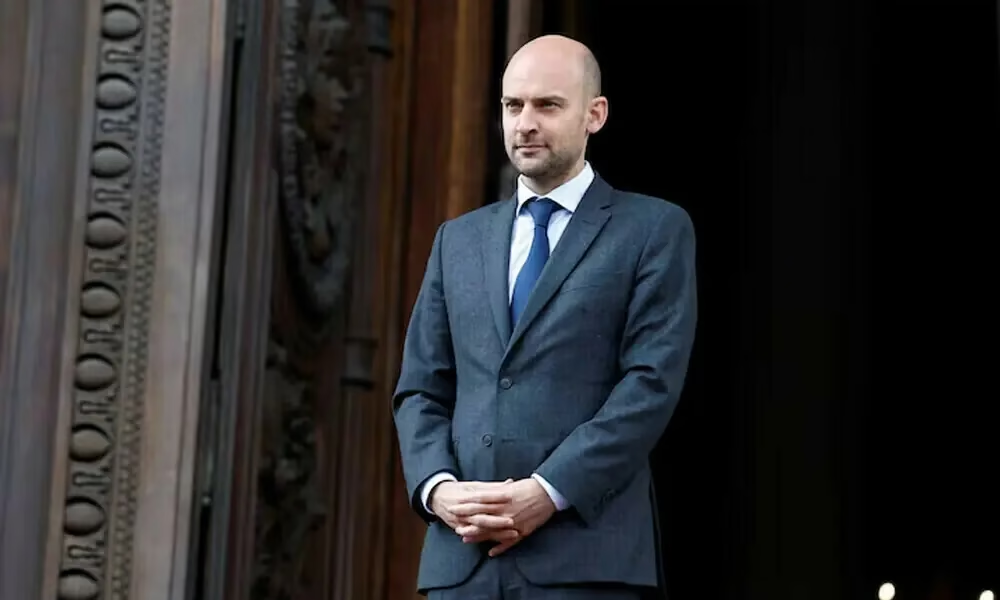
French Foreign Minister Jean-Noel Barrot clarified that the decision to establish the France Greenland consulate was not a reactionary step but part of a longer-term strategy to strengthen France’s presence in the Arctic. Speaking on French radio, Barrot emphasized that Greenland’s status as an autonomous territory within the Kingdom of Denmark must be respected, and that diplomatic engagement—not pressure should guide relations among allies.
Greenland has become increasingly important on the global stage due to its strategic location, natural resources, and role in Arctic shipping routes. Melting ice has opened new possibilities for trade and exploration, making the region more attractive to global powers. Against this backdrop, the opening of the France Greenland consulate reflects France’s intent to remain actively involved in Arctic affairs through diplomatic and cooperative means.
Barrot was particularly critical of rhetoric suggesting that the United States might seek control over Greenland. He stated that such language amounts to blackmail and should stop immediately. According to him, threatening or pressuring an autonomous territory linked to a NATO member undermines alliance unity. His remarks underline France’s position that disputes among allies should be resolved through dialogue and respect for international norms.
The France Greenland consulate is also symbolic of broader European concerns about maintaining balance in the Arctic. As competition increases among major powers, European nations are keen to ensure that Arctic governance remains rules-based and inclusive. By establishing a permanent diplomatic presence, France signals its commitment to engaging Greenland directly on issues such as climate change, sustainable development, and regional security.
From Greenland’s perspective, the opening of the consulate may offer additional diplomatic channels and opportunities for cooperation. France has shown interest in scientific research, environmental protection, and climate monitoring in the Arctic—areas that align closely with Greenland’s priorities. The France Greenland consulate could therefore serve as a platform for collaboration beyond traditional diplomacy.
Barrot also pointed out that any suggestion of attacking or coercing a NATO ally makes little sense strategically. He argued that such actions would contradict the interests of the United States itself and weaken the cohesion of the alliance. This statement reflects growing unease in Europe about unilateral approaches to foreign policy, particularly in strategically sensitive regions like the Arctic.
The timing of the France Greenland consulate opening is significant. As global attention increasingly shifts northward, Arctic diplomacy is becoming more complex. Climate change, resource access, and security considerations are deeply intertwined, requiring careful coordination among stakeholders. France’s move can be seen as an effort to contribute constructively to this evolving landscape.
Importantly, French officials stressed that the consulate’s establishment was planned well before the latest political statements from Washington. This clarification aims to prevent the move from being interpreted as a direct response to US pressure. Instead, France presents the France Greenland consulate as part of a consistent foreign policy approach focused on engagement, stability, and multilateral cooperation.
In the broader context, the situation highlights how Greenland has shifted from being a relatively overlooked territory to a focal point of international interest. As major powers reassess their Arctic strategies, diplomatic missions like the France Greenland consulate are likely to become more common. These developments underscore the need for clear communication, respect for sovereignty, and cooperation among allies.
The opening of France’s consulate in Greenland represents more than a routine diplomatic expansion. It reflects changing geopolitical realities in the Arctic and France’s determination to play an active, principled role in the region. At a time of heightened rhetoric and strategic competition, the France Greenland consulate stands as a reminder that diplomacy remains a vital tool for managing global challenges.