The ongoing Islamabad tree cutting controversy has triggered a heated debate in parliament, exposing differences within the ruling coalition as well as between the government and opposition. The issue surfaced prominently during a National Assembly session, where lawmakers questioned the scale, intent, and transparency of the tree-cutting drive in the federal capital. What began as an administrative action has now evolved into a broader discussion on environmental protection, public health, and urban planning.
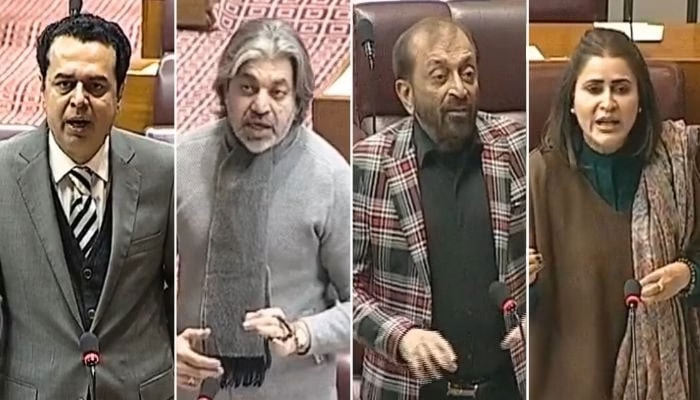
Raising concerns on the floor of the House, Pakistan Peoples Party (PPP) leader Shazia Marri termed the situation very serious,citing reports that thousands of trees had been cut in different areas of Islamabad, including Shakarparian. She stressed that such large-scale removal of greenery could have long-term environmental consequences. Her remarks reflected growing unease among government allies, signaling that the Islamabad tree cutting controversy is not limited to opposition criticism alone.
Muttahida Qaumi Movement-Pakistan (MQM-P) leader Dr Farooq Sattar echoed similar concerns, pointing out that some old and mature trees had reportedly been removed due to construction activities. He argued that cutting decades-old trees should not be justified under development plans and questioned whether proper alternatives had been considered. His comments added weight to the argument that urban expansion must be balanced with environmental preservation.
From the opposition benches, Pakistan Tehreek-e-Insaf (PTI) leader Ali Mohammad Khan acknowledged that removing wild paper mulberry trees due to pollen-related health issues could be understandable. However, he questioned why trees aged 40 to 50 years were also affected. This distinction became central to the Islamabad tree cutting controversy, as critics demanded clarity on whether the drive was truly limited to hazardous species or extended beyond that scope.
In response, the Islamabad district administration maintained that the campaign specifically targeted paper mulberry trees, which are known to cause severe pollen allergies in the capital. According to officials, the aim was to address public health concerns rather than generate revenue or facilitate unchecked development. Despite these assurances, skepticism persisted among lawmakers, leading to demands that the matter be referred to the National Assembly’s Standing Committee on Environment.
Minister of State for Interior Talal Chaudhry addressed the House to defend the government’s position. He categorically stated that only allergy-causing paper mulberry trees were removed and claimed that Islamabad was now “greener than before.” He announced that over 40,000 mature trees had already been planted, with an additional 60,000 scheduled by the end of March. According to him, these efforts directly counter claims fueling the Islamabad tree cutting controversy.
Chaudhry further explained that tree removal in Islamabad generally occurs under three defined circumstances: development under the city’s original master plan, essential infrastructure projects such as roads and underpasses, and the removal of hazardous species. He emphasized that areas often perceived by the public as green zones were, in fact, designated as brown-area sectors in the master plan. No infrastructure project in the past eighteen months, he said, had proceeded without mandatory public hearings, Environmental Protection Agency (EPA) reviews, and formal certification.
To support his claims, the minister cited data from SPARCO imagery, Google Maps, and NDVI (Normalized Difference Vegetation Index) analysis, stating that Islamabad’s green cover had actually increased between 2023 and 2025. He invited parliamentarians and journalists for on-ground technical briefings to verify these findings. According to him, uprooting paper mulberry requires significant resources and does not generate any financial benefit, undermining allegations of commercial motives behind the drive.
The Islamabad tree cutting controversy also drew attention from the federal climate leadership. Climate Change Minister Musadiq Malik visited Shakarparian to personally inspect the situation. He warned that strict action would be taken if local or native trees were found to be cut due to negligence or in violation of environmental guidelines. While defending the removal of paper mulberry, he highlighted that pollen allergies affect nearly 30 to 37 percent of the population, framing the drive as a public health necessity.
Despite these explanations, lawmakers from both sides agreed that further scrutiny was required. The matter was eventually referred to the relevant parliamentary committee for detailed examination. This move suggests that while the government maintains confidence in its environmental claims, political and public concerns cannot be dismissed outright.
The Islamabad tree cutting controversy underscores a deeper challenge faced by growing cities: balancing development, environmental sustainability, and public health. As the committee review progresses, the outcome may set an important precedent for how urban environmental decisions are communicated, monitored, and justified in Pakistan’s capital.