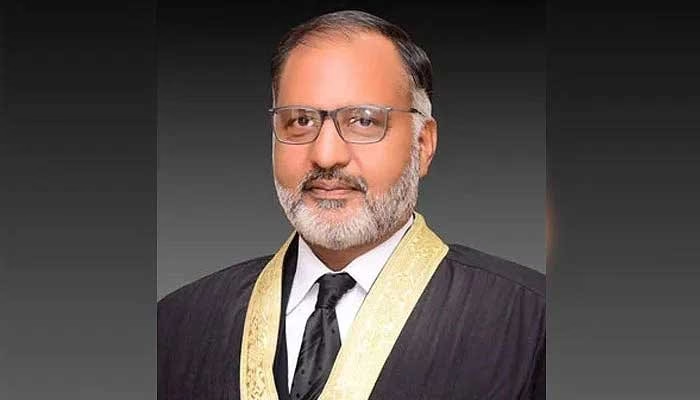
The Shaukat Aziz Siddiqui resignation has once again brought questions of judicial independence, integrity, and institutional credibility into the national spotlight. Speaking at a farewell reference, former Islamabad High Court judge Shaukat Aziz Siddiqui clarified that he resigned immediately after learning that his appointment as chairman of the National Industrial Relations Commission (NIRC) was being described as compensation.According to him, the moment the position was framed in that manner, he chose to step down without hesitation.
The Shaukat Aziz Siddiqui resignation was not a sudden or impulsive move, as the former judge explained in detail. He revealed that Law Minister Azam Nazeer Tarar had contacted him in November 2024 with an offer to assume the role of NIRC chairman. Siddiqui formally took charge on December 4, 2024, at a time when the institution was reportedly facing pressure and uncertainty about its future. Accepting the role, he said, was not about status or reward but about taking on a difficult challenge.
During his address, Siddiqui highlighted the condition of the NIRC when he assumed office. At that time, the commission was burdened with 5,380 pending cases. By December 31, 2025, he stated that 5,261 cases had been decided. At the same time, 5,522 new cases were filed, a development he interpreted as a sign of growing public trust in the institution. This performance record, he argued, demonstrated that the commission was functioning effectively under his leadership.
The Shaukat Aziz Siddiqui resignation gained further attention because of the reasoning behind it. Siddiqui emphasized that he does not “run after positions” and that he makes decisions based on conscience rather than calculation. He noted that throughout his career, speaking openly had often cost him dearly, yet he continued to do so. In his view, remaining silent in the face of something he considered morally questionable would have been a greater loss than resigning from a prestigious post.
Addressing questions about why he did not continue and challenge the narrative from within the system, Siddiqui was clear. He said he did not want any favor, nor did he wish to be seen as benefiting from what he believed was an inappropriate justification for his appointment. The moment the NIRC chairmanship was described as compensation, he felt it compromised his principles. As a result, the Shaukat Aziz Siddiqui resignation became, in his words, an unavoidable decision.
Siddiqui also reflected on the personal cost of his choices. He stated that allegations and damage to his career were matters he left to Allah, whom he described as the best judge. This expression of faith underscored his belief that moral accountability ultimately transcends institutional processes. For his supporters, this stance reinforced his image as a judge unwilling to compromise on principles. For critics, it raised further debate about the broader system and the circumstances that lead senior judges to make such dramatic exits.
The farewell reference also included remarks that hinted at unresolved tensions with members of the media. Siddiqui addressed journalist and YouTuber Matiullah Jan, who was present at the event, stating that the time had come for them to sit face to face. He suggested that such a discussion would clarify long-standing controversies and accusations, though he did not elaborate in detail during the event. This moment added another layer of public interest to the Shaukat Aziz Siddiqui resignation, showing that the issues surrounding his career are not confined to institutions alone.
In the larger context, the Shaukat Aziz Siddiqui resignation raises important questions about how judicial appointments are perceived and presented. Even when an institution shows measurable performance improvements, the framing of an appointment can overshadow achievements and trigger ethical concerns. Siddiqui’s decision serves as a reminder that credibility in public office depends not only on actions but also on intent and perception.
This episode is likely to remain part of ongoing discussions about judicial independence and accountability in Pakistan. Whether viewed as a principled stand or a controversial exit, the Shaukat Aziz Siddiqui resignation has once again highlighted the fragile balance between authority, integrity, and public trust in state institutions.