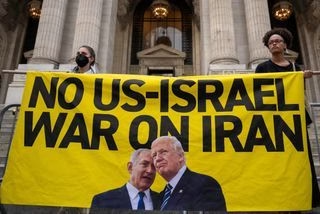
Several US lawmakers from both major political parties have expressed doubts over whether military action against Iran would serve American interests, as the country grapples with its largest wave of anti-government protests in years.
President Donald Trump has recently left open the possibility of US intervention, while Iranian authorities have blamed the unrest on terrorists and vowed to protect the ruling system. However, concerns about the consequences of military action were raised by at least two senators during Sunday television interviews.
Republican Senator Rand Paul, speaking on ABC News’ This Week, questioned the effectiveness of bombing Iran, warning that such action may not achieve its intended goals. He, along with Democratic Senator Mark Warner, cautioned that a military strike could instead unite Iranians against an external enemy rather than weaken the regime.
Appearing on Fox News Sunday, Senator Warner pointed to historical precedent, noting that US intervention — particularly the US-backed overthrow of Iran’s government in 1953 — contributed to events that eventually led to the establishment of the Islamic regime in the late 1970s. He warned that a similar move today could once again backfire.
Meanwhile, The Wall Street Journal reported that US military and diplomatic officials are scheduled to brief President Trump on Tuesday regarding potential options for Iran, including cyber operations and possible military action.
Iran has warned that it would retaliate by targeting US military bases if attacked. In contrast to calls for restraint, Republican Senator Lindsey Graham advocated a hardline approach, urging Trump to strongly support protesters and intimidate Iran’s leadership. Speaking on Fox News’ Sunday Morning Futures, Graham called for decisive action against leaders he accused of killing their own people.
In a related development, Reza Pahlavi — the US-based son of Iran’s former shah who was ousted in 1979 — said he is ready to return to Iran to help lead a transition toward democracy. In an interview on Sunday Morning Futures, Pahlavi said his goal is to oversee a transparent process that allows Iranians to freely elect their leaders and determine their country’s future.