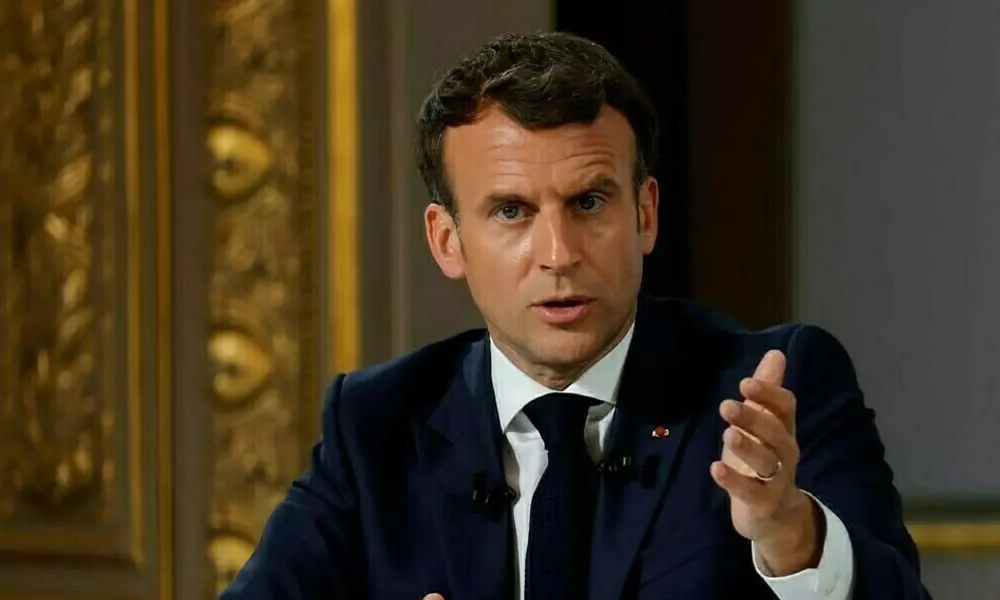
French President Emmanuel Macron has sharply criticised the US breaking free from international rules and distancing itself from long-standing allies, highlighting growing unease in Europe over Washington’s recent foreign policy actions. Delivering his annual speech to French ambassadors at the Élysée Palace, Macron framed the comments within a broader concern about the erosion of multilateral norms and institutions that have underpinned global cooperation for decades.
A Turning Point in Transatlantic Relations
In his address, Macron stated that the United States, while remaining a major global power, appears to be gradually turning away from some of its allies and breaking free from international rules that it was still promoting recently. This assessment reflects uneasiness among European leaders about the direction of U.S. foreign policy, particularly under President Donald Trump’s administration.
Macron’s remarks come amid high-profile international incidents that have strained relations, including Washington’s controversial military operation in Venezuela that resulted in the capture of President Nicolás Maduro, as well as provocative talk of U.S. designs on Greenland. European capitals are now scrambling to forge a coordinated response to what they see as assertive American strategic moves.
Concerns About Multilateral Institutions
A central theme of Macron’s speech was the declining effectiveness of multilateral institutions. Multilateral institutions are functioning less and less effectively, he told ambassadors, adding that the world is increasingly shaped by great powers with a temptation to divide up the world.Macron’s language underscores a broader European anxiety that global governance frameworks such as the United Nations, NATO, and international law are under pressure from unilateral actions by major states.
This critique highlights a divergence in strategic priorities. While Europe emphasizes rule-based international order and collective action, Macron suggests that the United States may be shifting toward a more unilateral, transactional approach. Such shifts raise questions about the future of long-standing alliances and shared security commitments forged in the post-World War II era.
European Autonomy and Strategic Interests
Macron used the speech to argue that Europe must protect its own interests, calling for the consolidation of European regulation and strategic autonomy. He particularly stressed the importance of strengthening Europe’s regulatory framework in the tech sector. Macron highlighted two major European laws the Digital Markets Act (DMA) and the Digital Services Act (DSA) as essential defenses against what European officials view as unaccountable dominance by large technology platforms and external pressure from Washington.
His emphasis on regulation is part of a broader vision for Europe to assert greater control over its economic and technological future, ensuring that decisions about information spaces and economic competition are made in accordance with European values rather than external influence.
Reaction from Washington and Allies
The United States has responded defensively to some European regulatory moves, particularly those seen as targeting American tech firms. Washington has described the DMA and DSA as efforts to coerce U.S. platforms into content moderation practices they oppose. Macron, however, insisted these regulations must be defended as part of Europe’s sovereignty and its right to shape its internal market.
Despite rising tensions, shared strategic interests such as NATO cooperation and collective responses to challenges in Eastern Europe and the Indo-Pacific continue to bind the United States and its European partners. Yet Macron’s comments signal a clear willingness in Paris to openly critique Washington’s approach when necessary.
Implications for Global Politics
Macron’s critique of the US breaking free from international rules points to a larger recalibration in global politics. European leaders are increasingly vocal about the need for strategic independence while continuing to engage with international partners. At the same time, there is a growing sense that traditional alliances may no longer function as they once did.
Critics argue that U.S. unilateralism could weaken global norms that have promoted peace and cooperation. These norms, established through treaties and shared commitments, have historically provided a framework for resolving disputes and coordinating collective action on issues ranging from security to climate change.
A Call for Renewed Cooperation
In urging Europe to protect its interests, Macron did not call for a rupture with the United States but rather for clearer understanding and mutual respect within the alliance. His speech suggests that Europe must be prepared to act both with and without Washington when necessary, especially in an era marked by shifting power dynamics and geopolitical competition.
While the transatlantic relationship remains vital, Macron’s message underscores the need for a renewed consensus on international rules, shared values, and the future direction of global governance. As debates continue over sanctions, strategic autonomy, and the role of multilateral institutions, Macron’s critique of the US breaking free from international rules will likely shape discussions in capitals across Europe and beyond in the months ahead.