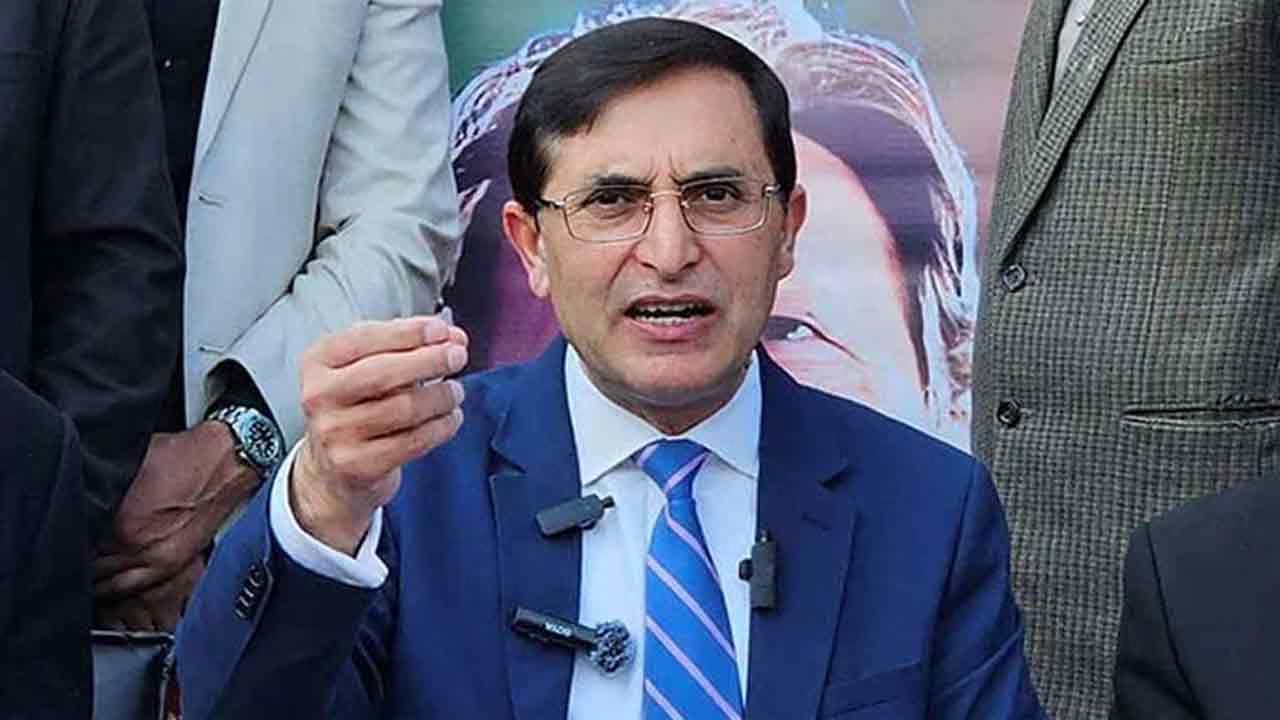
Pakistan’s fragile political climate once again came into focus after recent statements by PTI Chairman Barrister Gohar Ali Khan, clearly outlining the party’s position on dialogue. The PTI negotiation stance has become a key talking point as questions grow over whether meaningful talks are still possible amid rising mistrust and limited access to the party’s incarcerated founder, Imran Khan.
PTI’s Conditional Approach to Talks
Speaking to Dunya News, Barrister Gohar Ali Khan stressed that the party does not oppose dialogue in principle. According to him, if individuals or groups attempt to initiate talks, PTI does not condemn such efforts. However, he drew a firm line between individual initiatives and the party’s official position, clarifying that PTI itself is not part of any unofficial negotiation attempts.
This clarification is central to understanding the current PTI negotiation stance, which revolves around authority, legitimacy, and access. Barrister Gohar stated that Imran Khan, the party’s founder, has authorised only one person Mahmood Khan Achakzai to engage in negotiations on PTI’s behalf.
Authority Lies With the Founder
A recurring theme in Barrister Gohar’s remarks was the role of Imran Khan in any future dialogue. He made it clear that if the government or other stakeholders are serious about negotiations, they must engage directly with Khan Sahib. Without that engagement, any talks would lack substance and legitimacy from PTI’s perspective.
He further emphasised that the party does not have a negotiation committee, reinforcing that all political authority flows from the party founder. This position highlights how the PTI negotiation stance is deeply tied to concerns over access to leadership and decision-making power.
Demand for Family and Leadership Meetings
Barrister Gohar also outlined what he described as essential preconditions for any progress. First, he said that the family of Imran Khan should be allowed to meet Bushra Bibi. Second, PTI’s leadership must be granted a meeting with Khan Sahib himself.
These demands, he argued, are not political bargaining tools but basic requirements to restore trust. Without these meetings, PTI believes that dialogue cannot move forward in a meaningful way. This insistence further reflects the rigidity of the current PTI negotiation stance, shaped by what the party views as unjust restrictions.
PTI as the Sole Opposition
Another strong assertion made by Barrister Gohar was that PTI remains the only real opposition party in the country. He dismissed the idea that parallel or informal talks could represent PTI’s interests, stating that individuals negotiating on their own do not speak for the party.
This statement reinforces PTI’s narrative that any political settlement excluding them or bypassing their leadership is unlikely to hold. The PTI negotiation stance therefore positions the party as indispensable to any broader political reconciliation.
Frustration Over Blocked Access
Barrister Gohar expressed frustration over being denied access to prisoners, including Imran Khan. He revealed that he attempted to meet incarcerated individuals but was not permitted to do so. According to him, these restrictions have contributed to a sense that negotiations have effectively stalled.
I think the negotiations have reached a dead end, he said, adding uncertainty about how or whether talks could resume. This admission suggests growing pessimism within PTI about the immediate prospects for dialogue, despite public statements from the government about reconciliation.
Political Impasse and Trust Deficit
The broader context surrounding the PTI negotiation stance is one of deep mistrust between political actors. While the government has repeatedly spoken about the need for dialogue and confidence-building, PTI leaders argue that actions on the ground contradict these claims.
From PTI’s perspective, the denial of meetings, continued legal cases, and restrictions on communication signal a lack of seriousness about negotiations. As a result, even well-intentioned proposals are met with skepticism.
Impact on Political Stability
Analysts believe that PTI’s firm position could prolong the political impasse. By insisting on direct engagement with Imran Khan and rejecting unofficial channels, PTI has narrowed the space for compromise. However, supporters argue that this approach is necessary to protect the party’s mandate and prevent behind-the-scenes deals.
The PTI negotiation stance also reflects a broader challenge in Pakistan’s politics: balancing institutional processes with the influence of powerful political personalities. Until this balance is addressed, dialogue efforts may continue to falter.
Barrister Gohar Ali Khan’s recent remarks underline a hardening of PTI’s position at a time when political reconciliation is widely seen as essential for stability. The PTI negotiation stance makes one thing clear: without direct access to Imran Khan and recognition of authorised leadership, PTI sees little value in talks.
As uncertainty deepens and trust remains scarce, the path forward appears increasingly narrow. Whether stakeholders can bridge this gap will determine not only the future of negotiations but also the broader trajectory of Pakistan’s political landscape.