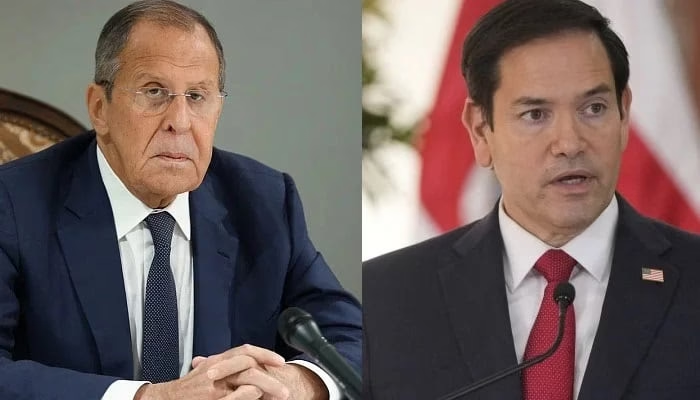
The United States’ top diplomat has said he will meet Danish leaders next week, but made clear that Washington is not backing away from President Donald Trump’s stated objective of taking control of Greenland—an ambition that has alarmed European allies and prompted discussions on a coordinated response.
US Secretary of State Marco Rubio told reporters on Wednesday that while diplomacy remains the preferred path, President Trump continues to retain the option of using military means to pursue US interests, including Greenland. His remarks came amid heightened concern following a recent US military operation in Venezuela, which revived fears about Washington’s intentions toward the strategically located Arctic island.
A forcible takeover of mineral-rich Greenland—an autonomous territory of Denmark and a long-standing US ally—would send shockwaves through NATO and further strain relations between Washington and European capitals. The issue has also sparked rare bipartisan concern in the US Congress, where lawmakers have indicated the Senate may eventually vote on legislation to limit Trump’s authority to attempt such a move.
Trump has long argued that Greenland is critical to US national security, citing its strategic position between North America and Europe and its role in ballistic missile defence. He has also pointed to its mineral wealth as part of Washington’s effort to reduce reliance on China. Although the US already enjoys broad military access to Greenland under defence agreements signed in 1951 and 2023, Trump has insisted Denmark has not done enough to safeguard the territory.
The White House confirmed this week that multiple options for acquiring Greenland are under discussion, including the possible use of force, despite strong European objections. While some US officials have suggested purchasing the island remains the primary goal, Trump’s refusal to rule out military action has unsettled allies.
European leaders, along with Canada, have rallied behind Denmark and Greenland, stressing that the island belongs to its people. Britain, France, Germany, Poland, Finland, and the European Union have all signalled support for Danish sovereignty and warned against violations of international law. Several European officials have called for the issue to be raised within NATO, arguing that unilateral action by the US would undermine the alliance.
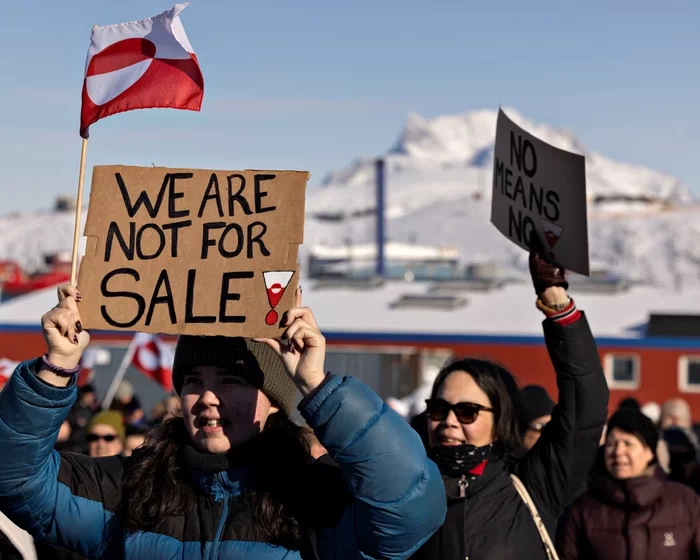
Danish Foreign Minister Lars Lokke Rasmussen and Greenland’s foreign affairs minister have requested an urgent meeting with Rubio, urging a shift from heated rhetoric to constructive dialogue. Greenlandic leaders have once again rejected any suggestion of annexation, insisting the territory is not for sale under any circumstances.
Denmark has also pushed back against Trump’s claims of growing Russian and Chinese activity around Greenland, saying such assertions are exaggerated and unsupported by available vessel-tracking data.
As diplomatic efforts intensify, the Greenland issue is emerging as a major test of transatlantic unity, state sovereignty, and the future direction of US foreign policy under Trump.