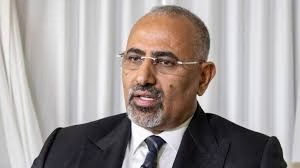
The leader of Yemen’s Southern Transitional Council (STC), Aidarous al-Zubaidi, failed to board a plane scheduled to take him to Riyadh and instead fled to an unknown location, the Saudi-backed coalition said on Wednesday.
The development comes amid efforts to contain fighting that erupted last month between the STC, which is backed by the United Arab Emirates, and Yemen’s internationally recognised government supported by Saudi Arabia. The clashes have deepened tensions between the two Gulf allies.
Zubaidi was expected to travel to Saudi Arabia days after Yemen’s government requested Riyadh to host talks on the southern issue. However, coalition spokesperson Turki al-Maliki said a flight carrying several senior STC leaders departed after a delay of more than three hours without Zubaidi, and his whereabouts remain unknown.
Maliki added that during the delay, information emerged suggesting Zubaidi had moved large forces and issued calls for mobilisation, including the movement and arming of factions with light and medium weapons.
The dispute has further fractured the Saudi-UAE coalition, which was originally formed to fight the Iran-aligned Houthi movement. The Houthis remain Yemen’s strongest military force and have controlled the capital, Sanaa, since 2014.
The coalition also said it carried out limited pre-emptive airstrikes in Yemen’s southern province of al-Dhalea after monitoring suspicious armed movements. Local and STC sources reported more than 15 airstrikes in the province, which is Zubaidi’s birthplace.
Following these developments, Yemen’s Saudi-backed presidential council removed Zubaidi from its membership and referred him to the public prosecutor on charges including high treason, according to state news agency SABA. The decision accused him of inciting armed rebellion, attacking constitutional authorities, and committing abuses against civilians in southern Yemen.
Despite these actions, the STC has for years been part of Yemen’s internationally recognised government, highlighting the deep political and military divisions within the country.
The leader of Yemen’s Southern Transitional Council (STC), Aidarous al-Zubaidi, failed to board a plane scheduled to take him to Riyadh and instead fled to an unknown location, the Saudi-backed coalition said on Wednesday.
The development comes amid efforts to contain fighting that erupted last month between the STC, which is backed by the United Arab Emirates, and Yemen’s internationally recognised government supported by Saudi Arabia. The clashes have deepened tensions between the two Gulf allies.
Zubaidi was expected to travel to Saudi Arabia days after Yemen’s government requested Riyadh to host talks on the southern issue. However, coalition spokesperson Turki al-Maliki said a flight carrying several senior STC leaders departed after a delay of more than three hours without Zubaidi, and his whereabouts remain unknown.
Maliki added that during the delay, information emerged suggesting Zubaidi had moved large forces and issued calls for mobilisation, including the movement and arming of factions with light and medium weapons.
The dispute has further fractured the Saudi-UAE coalition, which was originally formed to fight the Iran-aligned Houthi movement. The Houthis remain Yemen’s strongest military force and have controlled the capital, Sanaa, since 2014.
The coalition also said it carried out limited pre-emptive airstrikes in Yemen’s southern province of al-Dhalea after monitoring suspicious armed movements. Local and STC sources reported more than 15 airstrikes in the province, which is Zubaidi’s birthplace.
Following these developments, Yemen’s Saudi-backed presidential council removed Zubaidi from its membership and referred him to the public prosecutor on charges including high treason, according to state news agency SABA. The decision accused him of inciting armed rebellion, attacking constitutional authorities, and committing abuses against civilians in southern Yemen.
Despite these actions, the STC has for years been part of Yemen’s internationally recognised government, highlighting the deep political and military divisions within the country.