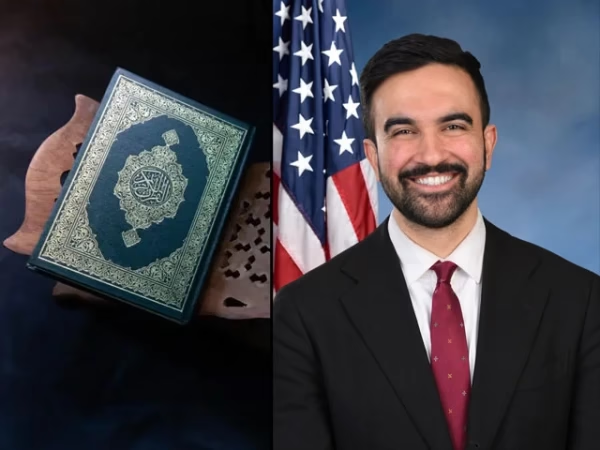
The Zahran Mamdani oath ceremony is set to make history in New York City as the newly elected mayor prepares to take office on January 1, 2026. This landmark event is drawing global attention because Mamdani will become the first Muslim mayor of New York City and the first to take the oath of office on the Holy Quran. The ceremony represents not just a personal milestone, but a powerful symbol of the city’s diversity, inclusion, and evolving identity.
The inauguration will take place in two parts, blending official tradition with public celebration. At the formal ceremony, Mamdani will take the oath on his grandfather’s Holy Quran, a deeply personal choice that reflects his faith and family heritage.
A Quran With Deep Historical Meaning
Adding further significance to the Zahran Mamdani oath ceremony, the mayor-elect will also take the oath on a second Holy Quran with remarkable historical value. This Quran once belonged to Arturo Schomburg, the renowned Black historian, writer, and cultural scholar whose work laid the foundation for modern Black history studies in the United States.
The Quran, preserved by the New York Public Library as part of Schomburg’s personal collection, carries symbolic weight beyond religion. Although Schomburg was not Muslim, his ownership of the Quran reflects his deep respect for global cultures, histories, and intellectual traditions. By using this sacred text, Mamdani is highlighting New York’s multicultural roots and the interconnected histories that shape the city.
Public Ceremony at City Hall
Later in the day, a public oath-taking ceremony will be held outside City Hall, allowing New Yorkers to witness the historic moment firsthand. US Senator Bernie Sanders is expected to administer the oath, underscoring the national significance of the occasion.
The event is also expected to be attended by outgoing Mayor Eric Adams, members of Congress, community leaders, and prominent social figures. The Zahran Mamdani oath ceremony is anticipated to draw large crowds, reflecting the enthusiasm and hope surrounding his election.
A Moment of Pride for Muslim New Yorkers
For Zahran Mamdani, this moment represents more than political success. He has described the oath ceremony as a source of pride for millions of Muslims living in New York and across the United States. Throughout his campaign, Mamdani emphasized that Muslim citizens deserve the same dignity, respect, and opportunities as any other New Yorker.
He consistently rejected the notion that minorities should lower their expectations or accept limited representation. The Zahran Mamdani oath ceremony stands as a visible affirmation of equality, signaling that faith and public service are not mutually exclusive in a democratic society.
Continuing a Tradition of Personal Faith
While Mamdani’s oath is historic, New York City has a longstanding tradition of mayors using religious texts that hold personal or historical meaning. Former Mayor Eric Adams took his oath on his family Bible, while Bill de Blasio used a Bible once owned by President Franklin D. Roosevelt. Michael Bloomberg chose the Jewish Bible from his bar mitzvah ceremony.
In this context, the Zahran Mamdani oath ceremony fits within a broader tradition of religious freedom and personal expression in public office, reinforcing the city’s commitment to pluralism.
Breaking Barriers in City Leadership
As the first Muslim mayor of New York City, Mamdani’s election reflects shifting demographics and growing political engagement among diverse communities. His leadership is widely seen as a milestone for representation, particularly at a time when issues of identity, inclusion, and civic participation are central to public discourse.
The oath on the Holy Quran is not merely symbolic; it sends a message that leadership in one of the world’s most influential cities can reflect a wide range of cultural and religious backgrounds without compromising democratic values.
What This Means for New York’s Future
The Zahran Mamdani oath ceremony marks the beginning of a new chapter for New York City. It signals a future where leadership mirrors the lived experiences of its residents and where faith, heritage, and public responsibility coexist.
As Mamdani takes office, expectations are high that he will govern with the same emphasis on equality and respect that defined his campaign. His inauguration is not just a ceremonial event, but a reflection of the city’s evolving identity as a global symbol of diversity and opportunity.
The Zahran Mamdani oath ceremony is a historic milestone that resonates far beyond City Hall. By taking the oath on the Holy Quran both a family heirloom and a powerful historical artifact Mamdani honors his roots while embracing the inclusive spirit of New York.
This moment stands as a reminder that democracy grows stronger when it reflects all of its people, their histories, and their beliefs.