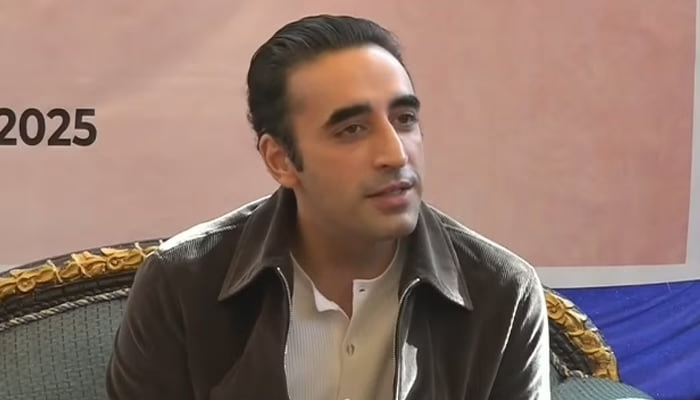
Bilawal urges PTI to step away from political extremism and return to democratic politics, sending a strong message amid Pakistan’s ongoing political uncertainty. Speaking to the media in Larkana, Pakistan Peoples Party (PPP) Chairman Bilawal Bhutto-Zardari warned that attacks on state institutions over political disputes only deepen instability and invite serious consequences.
In his remarks, Bilawal referred to the unrest that followed the arrest of PTI founder Imran Khan, stating that targeting state institutions over a meagre NAB case set a dangerous precedent. He stressed that political disagreements must be resolved within democratic and constitutional boundaries rather than through confrontation and violence.
Call for Democratic Responsibility
As tensions between major political parties continue, Bilawal urges PTI to renounce what he described as a hardliner and extremist political approach. According to him, returning to democratic norms would not only benefit the country but also protect PTI’s own workers, who have borne the brunt of legal and political fallout in recent months.
Bilawal, a former foreign minister and leader of a party allied with the ruling Pakistan Muslim League-Nawaz (PML-N), has consistently positioned himself as a proponent of dialogue and democratic continuity. He reiterated that political parties must find political solutions for the survival of democracy, warning that extremist politics naturally lead to strict state responses.
Opposition to Banning Political Parties
Despite strong criticism of PTI’s actions, Bilawal urges PTI supporters to note that he does not favor banning political parties. He maintained his stance against any prohibition on the Khan-founded party, arguing that such measures weaken democracy rather than strengthen it.
According to Bilawal, the focus should be on reforming political behavior instead of eliminating political actors from the system. He emphasized that inclusive politics, even with sharp disagreements, is healthier for democratic growth than exclusionary tactics.
Elections and the Need for Reform
Addressing the question of elections, Bilawal stated that it was “written on the wall” that polls would not be held anytime soon. He argued that rushing into elections without credible reforms would only worsen mistrust among political stakeholders.
Here again, Bilawal urges PTI and other parties to engage constructively in discussions around electoral reforms. He stressed the importance of creating an electoral system that all political forces and citizens can trust, saying transparent reforms are essential before any future vote.
Role of President Asif Ali Zardari
Bilawal also highlighted the potential role of President Asif Ali Zardari in easing political tensions. He suggested that, given the current climate, the president may need to act as a unifying figure to bring political parties to a common platform.
Dismissing rumors about a proposed 28th constitutional amendment, Bilawal clarified that such discussions exist largely in media speculation rather than in formal political circles. His focus, he said, remains on reconciliation rather than constitutional brinkmanship.
Reconciliation as a Way Forward
In earlier remarks to a public gathering, Bilawal had underscored the need for reconciliation to pull Pakistan out of overlapping political and economic crises. He warned that deepening political polarization was harming democracy, weakening the economy, and even affecting national security.
Once again, Bilawal urges PTI to recognize that political deadlock does not serve the country’s interests. He argued that political stability is directly linked to economic recovery, and without reducing polarization, Pakistan would struggle to address inflation, unemployment, and investor confidence.
Economic Concerns and Public Reality
Commenting on the economy, Bilawal said that the true measure of Pakistan’s economic health lies with ordinary citizens. Instead of relying solely on statistics, he suggested policymakers should listen to people struggling with rising living costs and limited income opportunities.
He also proposed public-private partnerships as one way to ease economic pressure, stressing that cooperation between the state and private sector could help generate jobs and stimulate growth. According to him, political stability is a prerequisite for any meaningful economic reform.
A Message to the Political Class
Overall, Bilawal urges PTI and the broader political class to reflect on the long-term consequences of confrontation. His message centered on restraint, dialogue, and constitutional politics as the only sustainable path forward.
At a time when Pakistan faces political uncertainty and economic stress, Bilawal’s call highlights a growing consensus among some leaders that reconciliation and reform, rather than escalation, are essential. Whether this appeal will resonate with PTI leadership and supporters remains to be seen, but the message is clear: democratic politics, not extremism, offers the only viable route to stability and progress.