US sanctions on Venezuela have once again taken center stage at the United Nations, as Washington announced it will enforce punitive measures “to the maximum extent” in an effort to deprive President Nicolás Maduro’s government of financial resources. The latest statements reflect a sharp escalation in diplomatic and military pressure, drawing strong reactions from Russia, China, and Venezuela itself.
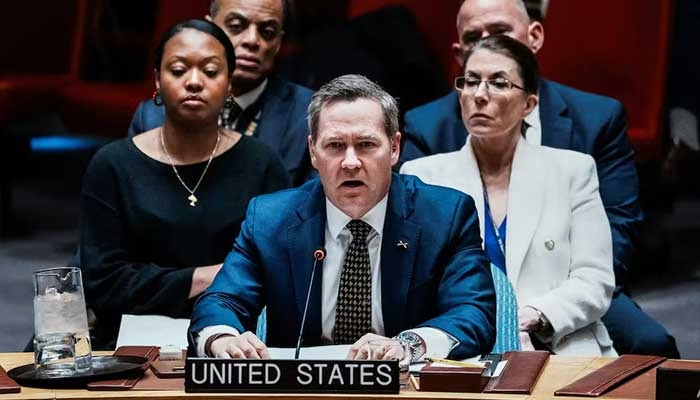
Speaking before the UN Security Council, the United States framed its actions as part of a broader campaign against transnational crime and drug trafficking in the Western Hemisphere. US officials argue that Venezuela has become a hub for criminal networks that threaten regional stability and US national security. This justification underpins Washington’s aggressive enforcement of maritime sanctions and its expanded military presence in the Caribbean.
Washington’s Rationale Behind the Sanctions
According to US Ambassador Mike Waltz, sanctioned oil tankers operating in the Caribbean serve as a key economic lifeline for the Maduro government. He claimed that proceeds from Venezuelan crude exports are being used to fund criminal organizations, including the alleged narco-terrorist group Cartel de los Soles. The United States recently designated this group as a foreign terrorist organization, accusing it of playing a central role in drug trafficking operations targeting the US.
The Venezuelan government has strongly rejected these accusations, calling the designation baseless and politically motivated. Caracas maintains that US sanctions on Venezuela are aimed not at combating crime, but at forcing regime change through economic pressure.
Increased Military Presence and Maritime Actions
As part of its enforcement strategy, the US has significantly increased naval and coast guard operations in the region. This month alone, the US Coast Guard intercepted two fully loaded Venezuelan oil tankers in the Caribbean Sea and began pursuing a third vessel near Venezuelan waters. President Donald Trump has also announced a blockade of vessels subject to US sanctions, further tightening restrictions on Venezuela’s oil exports.
These actions signal a shift from purely economic measures toward a more assertive posture that blends sanctions with military deterrence. US officials insist these steps are necessary to cut off illicit revenue streams, while critics argue they risk provoking a broader regional confrontation.
Russia and China Push Back
Russia has emerged as one of the most vocal critics of Washington’s approach. At the Security Council, Russian Ambassador Vassily Nebenzia warned that the current intervention could become a template for future uses of force against other Latin American countries. He cited US strategic documents emphasizing dominance in the Western Hemisphere, suggesting that Venezuela may not be the last target.
China echoed these concerns, urging the United States to halt its actions and avoid further escalation. Beijing has consistently opposed unilateral sanctions, arguing that they violate international law and undermine diplomatic solutions. Both Russia and China back Venezuela diplomatically and view US sanctions on Venezuela as destabilizing for the region.
Venezuela’s Legal Argument at the UN
Venezuela requested the Security Council meeting to challenge the legality of US actions. Its UN Ambassador, Samuel Moncada, argued that there is no armed conflict in the Caribbean that would justify the application of self-defense principles under international law. He dismissed Washington’s references to Article 51 of the UN Charter as an abuse of legal frameworks designed for wartime situations.
From Venezuela’s perspective, the sanctions and maritime interceptions amount to economic warfare rather than lawful self-defense. Caracas insists that such measures violate its sovereignty and threaten regional peace.
Regional and Global Implications
The dispute highlights growing divisions within the international community over the use of sanctions as a foreign policy tool. Supporters of US sanctions on Venezuela argue they are necessary to hold authoritarian governments accountable and disrupt criminal networks. Opponents counter that sanctions disproportionately harm civilians, worsen humanitarian conditions, and entrench political standoffs.
Latin American countries are watching closely, as increased militarization and sanctions enforcement could have spillover effects across the region. Energy markets, shipping routes, and diplomatic alignments all stand to be affected if tensions continue to rise.
With no immediate signs of de-escalation, the situation remains volatile. Venezuela, backed by Russia and China, is likely to continue raising the issue at international forums. Meanwhile, Washington appears committed to maintaining pressure until it sees meaningful political change in Caracas.
The future of US sanctions on Venezuela will depend largely on diplomatic negotiations that so far have failed to gain traction. Without dialogue, the risk of miscalculation grows, potentially drawing more regional and global actors into the conflict.
As the UN Security Council debates continue, the standoff serves as a reminder of how economic sanctions, military enforcement, and geopolitical rivalries intersect—often with consequences that extend far beyond the country at the center of the dispute.