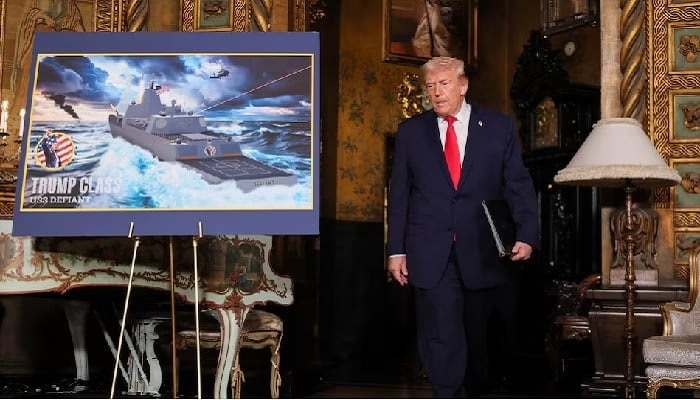
Trump class battleships became the centre of attention after President Donald Trump announced plans for a new generation of US warships, marking the beginning of an expanded naval buildup and a tougher stance toward defence contractors. The move reflects Trump’s desire to reshape the US military with larger, more powerful vessels while addressing long-standing concerns over delays, rising costs, and inefficiencies in defence production.
Speaking at a press event, President Trump revealed that the proposed ships would be significantly larger than current destroyers, weighing more than 30,000 tons. According to him, these vessels will incorporate the latest technologies, including artificial intelligence systems and directed energy lasers, positioning them among the most lethal surface warships in the world.
A New Era for the US Navy
The announcement of Trump class battleships is notable because the United States has not built a traditional battleship since the mid-1990s. Trump described this gap as a strategic weakness, especially at a time when global military competition is intensifying. While submarines remain the backbone of US naval power, Trump argued that advanced surface warfare ships are equally vital for projecting strength and maintaining dominance on the seas.
Trump also made it clear that he intends to be personally involved in the design process. He has previously criticised the appearance and practicality of existing US warships, suggesting that future vessels should be both visually imposing and technologically superior. This hands-on approach underscores how closely the project is tied to his leadership style and vision.
Technology and Firepower at the Core
One of the defining features of Trump class battleships is their emphasis on cutting-edge technology. The planned integration of artificial intelligence aims to enhance targeting, navigation, and battlefield decision-making. Directed energy lasers, meanwhile, are expected to provide new defensive and offensive capabilities, particularly against drones, missiles, and other emerging threats.
Defence analysts say such systems could significantly alter naval warfare by reducing reliance on traditional ammunition and improving response times. However, they also caution that integrating these advanced technologies into large platforms will require careful planning, testing, and sustained investment.
Strategic Context and Global Competition
Although some US officials have warned that China’s rapidly expanding navy has gained an edge due to America’s slow pace in building new surface ships, Trump downplayed China’s role in the decision. He described the expansion as a broad response to global security challenges rather than a direct counter to any single country.
Still, the timing of the Trump class battleships announcement reflects growing concern in Washington about maintaining naval superiority. China has launched numerous modern warships in recent years, while the US Navy has struggled with aging fleets and delayed replacement programs.
Pressure on Defence Contractors
Beyond the ships themselves, Trump used the announcement to signal increased scrutiny of defence contractors. He criticised what he described as an entrenched and inefficient defence industry, pointing to repeated cost overruns and production delays in major programs such as fighter jets and naval systems.
Trump said he plans to meet with leading defence firms to address these issues directly. He raised concerns about executive compensation, stock buybacks, and dividend payouts, suggesting that such practices may be diverting resources away from timely production. According to Trump, it is unacceptable for executives to earn tens of millions of dollars while critical defence projects fall behind schedule.
Reports have indicated that the administration is considering executive actions that would limit dividends, buybacks, and executive pay for contractors whose projects are significantly over budget or delayed. If implemented, such measures could reshape how defence companies manage their finances and priorities.
Industry Reaction and Challenges Ahead
The defence industry has reacted cautiously to the proposal. While many firms welcome long-term investment in naval expansion, they are also wary of tighter financial controls and increased oversight. Building Trump class battleships will require massive coordination across shipyards, technology providers, and the Pentagon, all while navigating budget constraints and regulatory requirements.
Experts note that large-scale naval projects historically face delays due to their complexity. Balancing Trump’s push for speed and cost discipline with the realities of advanced military manufacturing will be a major challenge.
A Broader Vision for Military Reform
The battleship announcement fits into Trump’s broader narrative of reforming the US military-industrial complex. He has repeatedly criticised what he sees as bloated processes and lack of accountability within defence procurement. By linking naval expansion with contractor reform, Trump is attempting to present a comprehensive approach to strengthening national defence.
Whether Trump class battleships ultimately meet expectations will depend on execution, funding, and sustained political support. If successful, they could redefine the role of surface warships in US naval strategy. If not, they risk becoming another example of ambitious defence plans hampered by cost and complexity.
The unveiling of Trump class battleships marks a significant moment in US defence policy, combining naval expansion with a push for industry accountability. With advanced technology, larger platforms, and heightened oversight of contractors, the initiative reflects President Trump’s assertive approach to military reform. As plans move forward, the project will be closely watched as a test of whether bold vision can translate into effective and efficient defence capability.