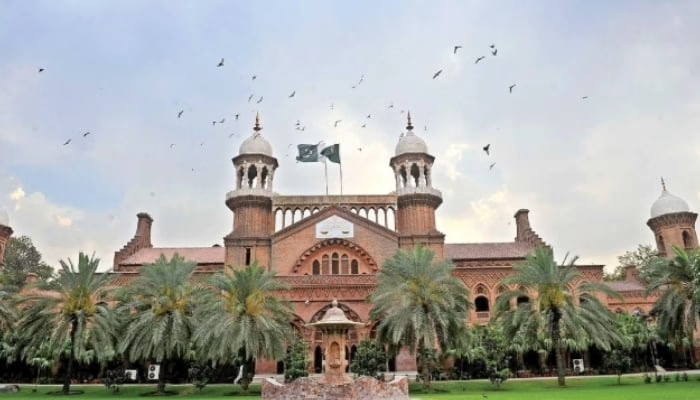
The Punjab property ordinance suspension ordered by the Lahore High Court has triggered intense legal and public debate, as questions arise over civil rights, judicial authority, and the balance of power between courts and the executive. On Monday, the court temporarily halted the enforcement of the Punjab Protection of Ownership of Immovable Property Ordinance, 2025, a law introduced by the provincial government to fast-track property dispute resolution and curb illegal occupation.
Background of the Ordinance
The Punjab government promulgated the ordinance with the stated aim of protecting lawful property owners and providing quick remedies against illegal possession. Under the law, Dispute Resolution Committees chaired by deputy commissioners and special property tribunals headed by former or serving district judges were given wide powers to resolve disputes. The ordinance also criminalised illegal occupation of property, prescribing strict punishments ranging from five to ten years of imprisonment and fines of up to Rs1 million.
Supporters of the law argued that it was necessary to combat land grabbing and long delays in civil courts. However, critics warned that the ordinance concentrated excessive authority in administrative hands, bypassing established judicial processes. These concerns ultimately led to the Punjab property ordinance suspension by the Lahore High Court.
Court Proceedings and Key Observations
The case was heard by Lahore High Court Chief Justice Aalia Neelum during proceedings on petitions filed by Abida Parveen and others. The court removed all procedural objections to the petitions and recommended the formation of a full bench to examine the matter in detail. Importantly, the court also ordered the repossession of properties that had been allocated under the new law, effectively rolling back actions taken since its enforcement.
Chief Justice Neelum delivered sharp remarks about the ordinance, questioning its intent and legal soundness. She observed that the law appeared to grant unchecked powers to certain officials without adequate safeguards. In a striking comment, she warned that if such a law remained in place, even high-profile properties could be transferred within minutes, highlighting the potential for abuse.
Concerns Over Civil Rights and Judicial Supremacy
A central reason behind the Punjab property ordinance suspension was the court’s concern that the law undermined civil courts and judicial supremacy. The chief justice noted that the ordinance bypassed traditional civil court proceedings and left citizens with little or no right to appeal. She questioned how a revenue officer could execute possession of a property when a matter was already under consideration by a civil court.
The court also expressed alarm over provisions that limit the high court’s ability to issue injunctions once a property has been handed over under the ordinance. According to the bench, this effectively strips citizens of constitutional protections and weakens judicial oversight.
Risk of Misuse and Administrative Overreach
Another major issue raised during the hearing was the potential misuse of authority by administrative officials. Chief Justice Neelum cautioned that patwaris and other revenue officers, if given sweeping powers, could collude with land-grabbing groups. She pointed out that the ordinance allowed complaints to be filed and properties to be transferred even on the basis of false documents or fake registrations.
The court also criticized what it described as an intimidating environment created by government committees, where citizens were allegedly warned of police action if they failed to comply with possession orders. Such practices, the court suggested, posed a serious threat to due process and fundamental rights.
Government’s Handling Under Scrutiny
The provincial government’s handling of the ordinance also came under scrutiny. The absence of the Punjab advocate general during the hearing drew criticism, although government counsel explained that he was unwell. The chief justice went further, questioning whether senior officials had even thoroughly reviewed the law before its promulgation.
Her remarks reflected broader judicial unease about legislation that appears to prioritize administrative efficiency over constitutional safeguards. This unease played a significant role in the Punjab property ordinance suspension, signaling the court’s intent to protect the legal framework governing property rights.
What Happens Next?
With the recommendation to form a full bench, the future of the ordinance now depends on a more comprehensive judicial review. The temporary halt does not permanently strike down the law, but it places its implementation on hold until constitutional and legal concerns are addressed.
Legal experts believe the case could set an important precedent. If the court ultimately rules against the ordinance, it may reinforce the primacy of civil courts in property disputes. If the government revises the law with stronger safeguards, it could still achieve its goal of protecting property owners without compromising rights.
The Punjab property ordinance suspension reflects a critical moment in Punjab’s legal landscape. While the fight against illegal occupation is a legitimate concern, the Lahore High Court has made it clear that speed and efficiency cannot come at the cost of civil rights and judicial authority. As the case moves toward a full bench hearing, its outcome will likely shape how property disputes are handled in the province for years to come.