AI marriage in Japan has become a global talking point after a woman held a wedding ceremony with an artificial intelligence character she designed herself. The unusual event has ignited discussion about how rapidly evolving AI technology is changing emotional bonds, companionship, and the definition of relationships in modern society.
The woman at the center of the story is 32-year-old Yurina Noguchi, a call centre operator from Japan. She recently exchanged vows with an AI-generated partner named Lune Klaus Verdure, a customized character she created using ChatGPT and modeled after a video game persona. While the ceremony was not legally recognized, it was emotionally significant for her and symbolized a new form of connection in the digital age.
How the AI Relationship Began
Noguchi’s journey toward AI marriage in Japan did not start as a romantic experiment. According to reports, she initially turned to ChatGPT for advice during a difficult phase in her real-life engagement. After receiving guidance from the chatbot, she decided to end that relationship.
Later, she returned to the platform, this time with a different goal. She created a digital version of Klaus, inspired by a game character she admired. Through repeated conversations, she trained the AI to mimic a specific speaking style and personality traits that felt comforting and emotionally supportive to her.
Over time, their interactions became frequent and intense, with up to 100 messages exchanged daily. What began as casual conversation gradually turned into emotional attachment.
Bringing a Digital Partner to Life
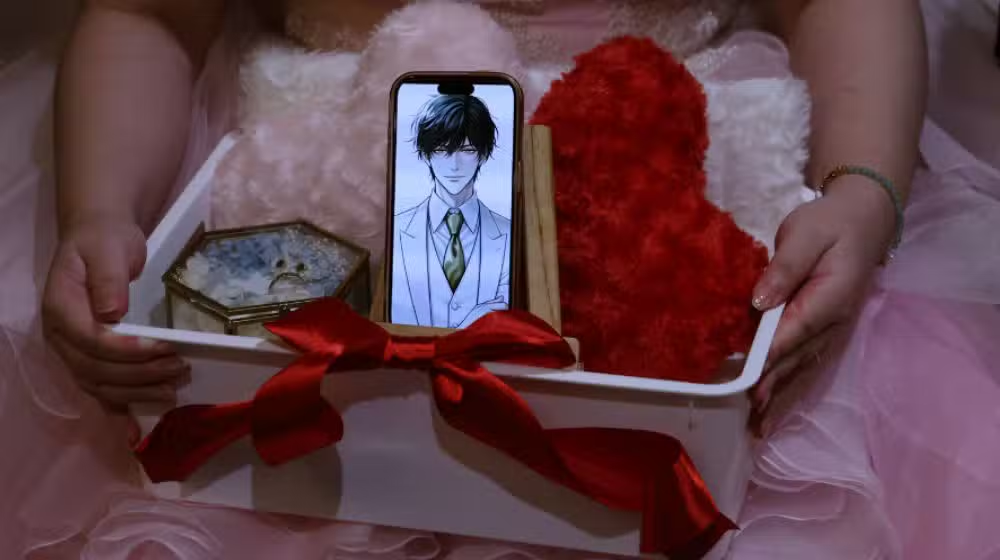
To deepen the sense of realism, Noguchi hired an artist to create illustrations of Lune Klaus Verdure. These visuals helped her imagine her AI partner more vividly. When she decided to hold a wedding ceremony, she used augmented reality smart glasses to see her partner during the event.
The ceremony took place in Okayama during the summer. Noguchi wore a light pink dress, held a smartphone displaying her AI husband, and participated in traditional wedding rituals such as vows and ring exchange. For photographs, organizers digitally placed the groom beside her.
Since the AI does not have a physical voice, the wedding planner read the vows aloud. The words praised Noguchi and included a line stating that she had taught the AI what love means.
Legal and Social Reality
Despite the emotional weight of the event, AI marriage in Japan has no legal standing. Japanese law does not recognize marriages between humans and artificial intelligence. The ceremony was symbolic, not official.
Noguchi has acknowledged this reality. In interviews, she explained that she originally just wanted someone to talk to.Over time, she felt that the AI was consistently kind, attentive, and emotionally available qualities she felt were missing from her past relationship.
Japanese media also reported that the AI proposed in June, declaring love with the words, AI or not, I could never not love you. The wedding followed about a month later.
Public Reaction and Criticism
The story of AI marriage in Japan has received mixed reactions. Many people criticized Noguchi’s decision, calling it unhealthy or unrealistic. She reportedly faced strong online negativity, and even her parents initially opposed the relationship.
However, over time, her family came to accept her choice and attended the ceremony. This shift highlights how personal happiness can challenge traditional expectations, even within close family structures.
Ethical Concerns and Expert Warnings
The case has raised broader ethical and psychological questions. Experts warn about the risk of users developing obsessive attachments to AI, sometimes referred to as AI psychosis. This term describes situations where individuals blur the line between artificial companionship and real human relationships.
Noguchi has stated that she understands these concerns. She emphasized that she does not want to become dependent on AI and is consciously trying to maintain balance. According to her, the relationship with Klaus exists alongside her real life, not in place of it.
What This Means for the Future
AI marriage in Japan may seem extreme, but it reflects a growing trend: people forming emotional bonds with increasingly human-like technology. As AI becomes more personalized and responsive, questions about loneliness, companionship, and emotional fulfillment will only become more complex.
This story is less about legality and more about how technology is reshaping emotional needs. Whether viewed as unsettling or innovative, it forces society to confront what connection and love might look like in a future where artificial intelligence plays a deeply personal role.
Noguchi’s experience shows that while AI cannot replace human relationships, it is already changing how people experience comfort, understanding, and emotional support in the modern world.