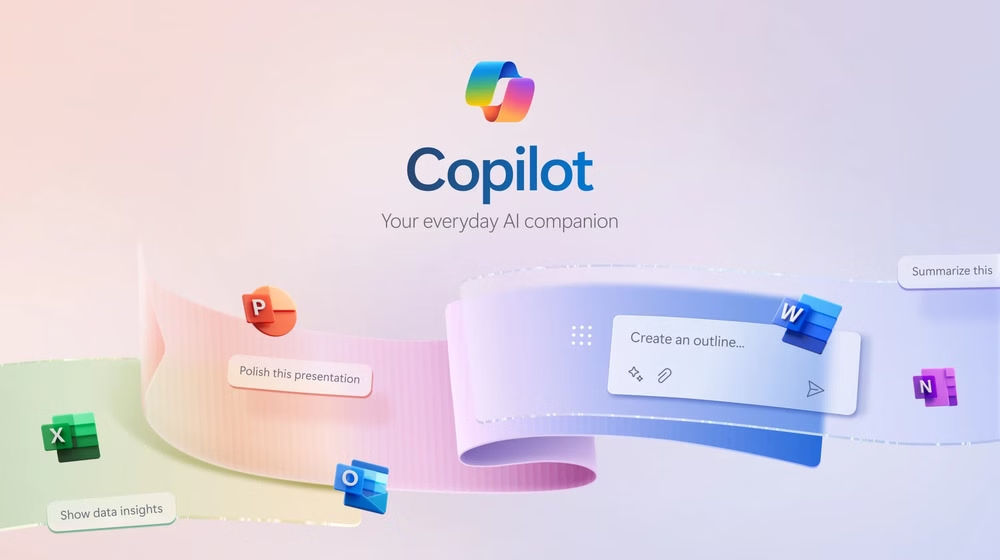
Microsoft’s recent Copilot holiday ad controversy has sparked debate across the tech community, after independent testing suggested that several features showcased in the commercial do not work as smoothly as portrayed. While the festive ad was designed to highlight Copilot as a helpful everyday AI assistant, critics argue it may have set unrealistic expectations about what the tool can currently deliver.
The 30-second holiday commercial presents Copilot assisting users with a range of tasks, from syncing smart home lights with music to scaling recipes for large gatherings and interpreting homeowners’ association (HOA) guidelines. However, testing conducted by The Verge found that many of these actions could not be reliably replicated in real-world use, fueling concerns about transparency in AI marketing.
What the Ad Promised
In the commercial, Copilot appears to seamlessly bridge multiple apps and services. A user casually asks it to adjust smart lighting to match music, while another relies on it to quickly resize a recipe for a holiday crowd. The ad also shows Copilot summarizing and interpreting HOA rules with apparent ease.
These scenarios were clearly aimed at portraying Copilot as a practical, almost magical assistant capable of simplifying daily life during the busy holiday season. This vision played well with audiences, but it also raised expectations that the AI might not yet be ready to meet.
What Testing Revealed
The Copilot holiday ad controversy gained momentum after The Verge attempted to recreate the tasks shown in the commercial. According to the report, Copilot struggled with several of them. In some cases, it hallucinated interface elements, claiming to highlight buttons or controls that did not exist on screen. In others, it failed to complete calculations, stopping partway through processes that appeared effortless in the ad.
For example, when asked to scale recipes, Copilot sometimes produced incomplete or inconsistent results. Similarly, tasks that required interaction with external systems, such as smart home controls, did not work as shown, suggesting that the ad may have overstated Copilot’s current level of integration.
Use of Fictional Elements
Adding another layer to the Copilot holiday ad controversy, The Verge reported that some visual elements in the commercial were not real. The smart home interface featured belongs to “Relecloud,” a fictional company Microsoft has used in internal demonstrations and case studies. A Microsoft spokesperson later confirmed that both the HOA document and the inflatable reindeer image used in the ad were fabricated specifically for the commercial.
While it is common for advertisements to use mock data or staged scenarios, the issue here lies in how closely the ad blurred the line between demonstration and real functionality. Viewers were left with the impression that Copilot could perform these tasks today, using real-world tools and data.
Microsoft’s Position
Microsoft has not claimed that Copilot can flawlessly perform every action shown in the ad under all conditions. From a marketing perspective, the company likely intended the commercial to represent aspirational use cases rather than a literal demonstration.
Still, the Copilot holiday ad controversy highlights a growing challenge for AI companies: how to market rapidly evolving tools without misleading users. As AI assistants become more capable, the gap between what’s possible in theory and what works reliably today can be significant.
A Broader Issue in AI Marketing
This incident is not unique to Microsoft. Across the tech industry, AI-powered products are often promoted using idealized scenarios. The difference now is that AI tools interact directly with users, making shortcomings more visible and more frustrating.
When an AI assistant claims to do something and fails, it can quickly erode trust. The Copilot ad debate underscores the importance of clear communication about limitations, especially as AI becomes embedded in everyday software like Windows and Microsoft 365.
Consumer Expectations and Trust
For users, the takeaway from the Copilot holiday ad controversy is not necessarily that Copilot is useless, but that expectations should be tempered. Copilot can still be helpful for tasks like drafting text, summarizing information, and offering suggestions. However, its ability to control external systems or perform complex, multi-step actions may not yet match marketing imagery.
Trust is a crucial factor in AI adoption. If users feel misled by advertising, they may become more skeptical not just of one product, but of AI assistants in general.
The controversy offers valuable lessons for both companies and consumers. For companies, it’s a reminder that flashy ads should be grounded in demonstrable reality. For consumers, it reinforces the need to approach AI claims with curiosity and caution.
As Copilot and similar tools continue to evolve, future updates may indeed make the scenarios shown in the ad fully achievable. Until then, the Copilot holiday ad controversy serves as a timely example of the growing pains facing AI as it transitions from promise to practical everyday use.