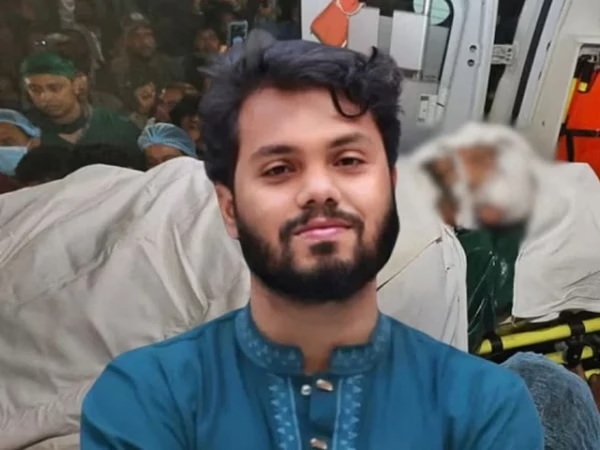
The Usman Hadi assassination has sent shockwaves across Bangladesh, triggering nationwide grief, unrest, and renewed debate about political violence in the country. Usman Hadi, a prominent student leader and a key figure in the movement that led to the ouster of former prime minister Sheikh Hasina, succumbed to his injuries after an assassination attempt that took place earlier this month in Dhaka.
From Dhaka to Singapore: A Fight for Life
Sharif Usman Hadi was critically injured on December 12 during an election campaign event in Dhaka’s Old Paltan area. According to reports, unidentified assailants on a motorcycle opened fire, with a bullet striking him in the head. He was immediately rushed to Dhaka Medical College Hospital and later shifted to a private medical facility as doctors struggled to stabilize his condition.
As his health continued to deteriorate, authorities arranged for his transfer to Singapore on December 15, hoping that advanced medical care could save his life. Despite the efforts of a specialized medical team at Singapore General Hospital, Usman Hadi passed away on Thursday night. News of his death quickly spread, intensifying public anger and sorrow back home.
A Hero’s Return and a Nation in Mourning
The body of Usman Hadi was flown back to Dhaka, draped in the national flag. Scenes at the airport were emotional and historic, as millions of students gathered to pay tribute to the fallen leader. Members of the interim government, including senior ministers, were present to receive the body, underscoring the national significance of the loss.
Chief Advisor of the interim government, Muhammad Yunus, announced that the funeral prayers would be held at 2 pm at the South Plaza of the Bangladeshi Parliament. He also declared a day of national mourning, with the national flag flying at half-mast and official ceremonies kept to a minimum.
In light of security concerns following the Usman Hadi assassination, authorities imposed strict measures around the funeral. Attendees were instructed not to bring bags or heavy items, and a complete ban was placed on flying drones in and around Parliament House.
Who Was Usman Hadi?
Sharif Usman Hadi was not just a student activist; he was a symbol of resistance for a generation. As a leading voice of the student movement that challenged decades of authoritarian rule, he emerged as a spokesperson for the political platform “Inqilab Mancha.” His speeches, organizational skills, and ability to mobilize youth made him one of the most influential figures in recent Bangladeshi student politics.
Supporters credit him with playing a decisive role in shaping the protests that ultimately led to the downfall of Sheikh Hasina’s long-serving government. To many young Bangladeshis, Hadi represented hope, reform, and democratic renewal.
Riots and Political Fallout
The Usman Hadi assassination sparked immediate unrest in Dhaka. Angry students took to the streets, torching offices linked to the former ruling party Awami League and attacking the homes of party activists. The violence reflected deep frustration and fear that the killing was part of a broader attempt to silence democratic voices.
Student organizations and political circles widely condemned the murder, describing it as a calculated conspiracy to suppress the student movement and roll back recent political gains. Many demanded a transparent investigation and swift justice for those responsible.
Allegations and Regional Tensions
According to preliminary reports, the attackers fled the scene on motorcycles and later crossed into India. This claim has added a regional dimension to the case, especially since Sheikh Hasina has reportedly been residing in India since her removal from office. While no official confirmation has been made regarding the identities of the assailants, the allegations have fueled speculation and heightened diplomatic sensitivities.
The interim government has pledged to pursue the perpetrators and ensure accountability, stating that political violence will not be tolerated in the new Bangladesh.
A Turning Point for the Student Movement
The Usman Hadi assassination may prove to be a defining moment for Bangladesh’s political future. While his death has left a leadership vacuum, it has also galvanized students and activists across the country. Many see his sacrifice as a rallying point that could strengthen demands for justice, transparency, and lasting democratic reforms.
As Bangladesh mourns, the legacy of Usman Hadi continues to inspire millions. Whether his death leads to deeper instability or becomes the catalyst for meaningful change will depend on how the state responds in the days and weeks ahead. One thing, however, is clear: Usman Hadi’s name has been etched into the country’s political history, not just as a victim of violence, but as a symbol of resistance and hope.