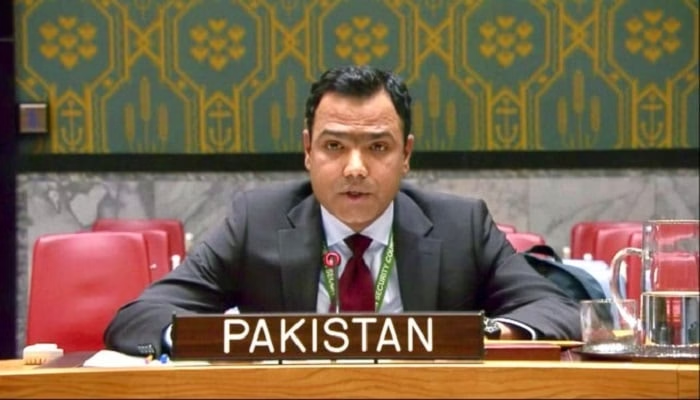
Pakistan forcefully reiterated its long-standing stance on the Kashmir dispute during a recent United Nations Security Council (UNSC) debate, once again rejecting India’s claim over the region. Speaking at the UNSC Open Debate on Leadership for Peace, Pakistan’s representative made it clear that Jammu and Kashmir is not, and will never be, a part of India. This firm position, centered on international law and UN resolutions, placed Pakistan Kashmir UNSC discussions back into the global spotlight.
From the outset of his address, Gul Qaiser Sarwani, Counsellor and Political Coordinator at Pakistan’s UN Mission, emphasized that Jammu and Kashmir is an internationally recognized disputed territory. He stressed that this position is not merely Pakistan’s narrative but is grounded in United Nations resolutions that acknowledge the unresolved status of the region. The Pakistan Kashmir UNSC stance, he said, reflects commitments made by India itself decades ago when the issue was first brought before the Security Council.
Sarwani recalled that India had accepted the obligation to allow the people of Jammu and Kashmir to decide their future through a UN-supervised plebiscite. Nearly eight decades later, that promise remains unfulfilled. Instead, he noted, India maintains a heavy military presence in the territory, restricting civil liberties and silencing dissenting voices. According to Pakistan, such actions violate international law and undermine the very principles the UN was established to uphold.
Addressing the human rights situation, Sarwani accused India of systematic repression in occupied Jammu and Kashmir. He alleged that measures aimed at altering the demographic character of the region were being pursued, which Pakistan views as a serious breach of international humanitarian and human rights law. In the Pakistan Kashmir UNSC narrative, these concerns are central to understanding why the dispute continues to pose a threat to regional peace.
Further Statement (RoR) by Gul Qaiser Sarwani,
— Permanent Mission of Pakistan to the UN (@PakistanUN_NY) December 16, 2025
Counsellor/Political Coordinator at Pakistan Mission,
In Response of the Indian Representative
At UNSC Open Debate on Leadership for Peace
(15 December 2025)
****
Madam President,
Pakistan takes the floor to respond to the remarks… pic.twitter.com/X7rsNuy0kW
Turning to India’s frequent allegations of cross-border terrorism, Pakistan’s representative rejected what he described as unfounded accusations. He argued that such claims are often used to divert attention from India’s own actions in the region. Sarwani went further, alleging that there is credible evidence of India’s involvement in sponsoring militant groups that have carried out attacks inside Pakistan. He also accused India of engaging in state-backed violence and assassination campaigns abroad, claims that India has consistently denied.
Pakistan, he said, has acted with restraint even in moments of heightened tension. Referring to recent incidents, Sarwani noted that Pakistan joined other members of the Security Council in condemning acts of violence and even offered an independent and credible investigation, which he said India rejected. Within the Pakistan Kashmir UNSC discourse, this was presented as evidence of Islamabad’s willingness to pursue peaceful and lawful solutions.
The speech also addressed the Indus Waters Treaty, an agreement often cited as a rare example of cooperation between the two countries. Sarwani rejected India’s recent remarks suggesting the treaty could be unilaterally suspended or modified. He described such interpretations as a distortion of a binding international agreement, warning against the “weaponisation of water” for political purposes. He cited a recent Court of Arbitration award that reaffirmed the treaty’s validity and dispute-resolution mechanisms, reinforcing Pakistan’s legal position.
Beyond Kashmir and water disputes, Sarwani questioned India’s claims of being a model democracy. He pointed to what he described as the erosion of civil liberties, suppression of dissent, and rising majoritarian extremism within India. Responding to Indian criticism of Pakistan’s internal laws and constitutional amendments, he asserted that such matters fall solely within Pakistan’s parliamentary and constitutional framework, free from external interference.
Concluding his remarks, Sarwani called for genuine leadership for peace in South Asia. He urged India to abandon denial, end its occupation of Jammu and Kashmir, and implement UNSC resolutions. Dialogue, respect for international law, and good neighbourly relations, he argued, remain the only viable path forward. The Pakistan Kashmir UNSC position, as reiterated in this debate, underscores Islamabad’s insistence that lasting peace in the region is impossible without a just and lawful resolution of the Kashmir dispute.
As discussions continue at international forums, Pakistan’s statements at the Security Council highlight that Kashmir remains a central and unresolved issue on the global agenda. The renewed focus on Pakistan Kashmir UNSC deliberations suggests that, despite the passage of time, the dispute continues to demand attention, accountability, and meaningful action from the international community.