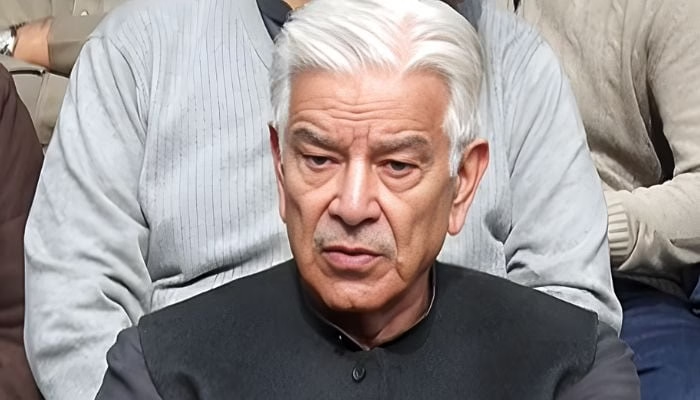
Khawaja Asif PTI allegations have once again brought Pakistan’s recent political history under sharp focus, as the defence minister accused conspiratorial elements of trying to restore Pakistan Tehreek-e-Insaf (PTI) founder Imran Khan to power. Addressing a press conference in Sialkot, Khawaja Asif said that hidden forces are still active and attempting to influence political outcomes despite recent developments.
Speaking candidly, Asif alleged that Imran Khan’s rise to power was not organic but engineered through manipulation and intimidation. He claimed that the former prime minister worked closely with now-convicted former ISI chief Faiz Hamid, whom he described as the central figure behind political victimisation during PTI’s tenure.
According to Asif, Faiz Hamid played a direct role in threatening political opponents and suppressing rival parties. He said that the entire victimisation process was allegedly executed through the former spymaster, who used his authority to influence politics. These Khawaja Asif PTI allegations suggest that state institutions were misused to sideline opponents and shape political outcomes.
The defence minister went on to claim that Faiz Hamid was effectively in charge of the PTI project.He alleged that Imran Khan was brought into power through coercion, manipulation, and pressure tactics, while leaders and workers of the Pakistan Muslim League-Nawaz (PML-N) were imprisoned to weaken political resistance. Asif said the political engineering during that period caused long-term damage to the country’s democratic framework.
Asif further stated that during Imran Khan’s four-year rule, Pakistan’s future was compromised under the supervision of Faiz Hamid. He warned that if their alliance had continued, the consequences for national stability could have been far more severe. Emphasizing accountability, he said those who acted against the state must be held responsible without exception.
Referring to Faiz Hamid’s conviction, Asif rejected claims that the legal process was rushed. He pointed out that the Field General Court Martial took over 15 months to complete the trial, calling it a thorough and lawful process. According to the Inter Services Public Relations (ISPR), Hamid was convicted on multiple charges, including engaging in political activities, violating the Official Secrets Act, misusing authority, and causing financial and personal harm to individuals.
The Khawaja Asif PTI allegations also extended beyond political engineering to include claims about the May 9 violence. Asif blamed both Imran Khan and Faiz Hamid for the unrest, describing it as part of a broader conspiracy. He alleged that the planning and strategic direction of the violence came from Hamid, while PTI supporters carried out the actions on the ground.
According to Asif, military installations and martyrs’ memorials were desecrated during the unrest, which he said crossed all red lines. He stressed that attacks on state institutions could never be justified under the banner of political protest. These incidents, he argued, exposed the dangers of politicizing national security and state authority.
The defence minister also stated that accountability would not stop with high-profile figures. He said the process would be extended to facilitators within the bureaucracy and other institutions who supported or enabled these actions. Asif emphasized that Pakistan could not move forward unless all those involved in undermining the state were identified and held accountable.
Concluding his remarks, Asif highlighted the contrast between the events of May 9 and the military’s later role in safeguarding national pride through Operation Bunyanum Marsoos. He said the armed forces proved their commitment to the country by restoring stability and elevating Pakistan’s standing after a difficult period.
The Khawaja Asif PTI allegations underline a broader debate about accountability, institutional integrity, and the role of power in Pakistan’s politics. As the country navigates these sensitive issues, the focus remains on ensuring transparency, justice, and the protection of democratic norms to prevent similar crises in the future.