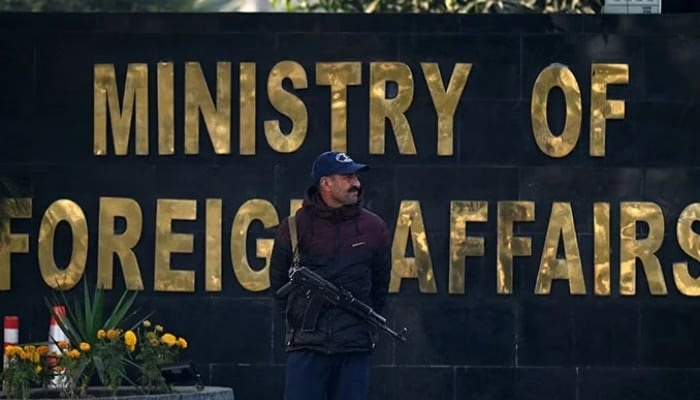
The Norwegian ambassador hearing controversy has sparked significant debate in Pakistan’s diplomatic and political circles. The Ministry of Foreign Affairs (MoFA) officially summoned the Norwegian envoy after he was seen attending a Supreme Court hearing in Islamabad, raising concerns about a breach of diplomatic protocol and potential interference in Pakistan’s internal affairs. This incident has turned into a major discussion point, with experts debating whether the ambassador’s presence was routine diplomatic observation or an overstep of international norms.
The Foreign Office spokesperson Tahir Andrabi confirmed that the additional Foreign Secretary (Europe) called in the ambassador to express Pakistan’s concerns. According to the spokesperson, the diplomat’s attendance at the courtroom was seen as a violation of established practices. Officials stated that such involvement could be interpreted as interference in domestic legal matters, which is strictly discouraged under the Vienna Convention on Diplomatic Relations.
During the meeting, the Norwegian envoy was reminded of the boundaries that govern diplomatic engagement. The MoFA highlighted that the ambassador’s presence in the Norwegian ambassador hearing incident was viewed as a breach of diplomatic protocol. Pakistan emphasized the importance of adhering to international laws that protect the sovereignty of states and prevent foreign diplomats from giving the impression of influencing judicial processes.
The situation escalated when it was reported that the ambassador attended a Supreme Court hearing related to the case of lawyer Imaan Mazari and her husband, Advocate Hadi Ali Chattha. The couple had been facing charges under several sections of the Prevention of Electronic Crimes Act (PECA) for allegedly inciting divisions through social media posts. The case has drawn national attention, but the unexpected attendance of the Norwegian diplomat added a diplomatic layer to a legal issue.
However, Imaan Mazari defended the ambassador’s visit. Responding to criticism on social media regarding the Norwegian ambassador hearing, she stated that foreign diplomats routinely observe court proceedings around the world. According to her, such observation does not mean participation or interference. She argued that it is part of standard diplomatic practice for envoys to monitor human rights issues, legal reforms, or cases that affect the civic climate of the host country.
While Mazari’s explanation aligns with general diplomatic norms practiced internationally, Pakistan’s Foreign Office maintained that, in this specific situation, the ambassador’s attendance appeared inappropriate. The ministry believed that the courtroom presence, especially during a sensitive case, risked being misinterpreted as political or legal involvement.
The Supreme Court’s decision to accept Mazari’s plea and halt the trial pending the Islamabad High Court’s final verdict further intensified attention on the case. With ongoing discussions surrounding freedom of expression, digital rights, and political activism in Pakistan, the Norwegian ambassador hearing incident added another dimension to an already complex legal and political landscape.
Diplomatic experts note that while observing public hearings is not uncommon for foreign envoys, context matters. Some argue that attending a politically sensitive case involving allegations of incitement could be interpreted differently by the host nation. Others believe that Pakistan’s reaction may be aimed at reinforcing state sovereignty and drawing a clear line on what is considered acceptable diplomatic conduct.
🔊PR No.3️⃣7️⃣3️⃣/2️⃣0️⃣2️⃣5️⃣
— Ministry of Foreign Affairs – Pakistan (@ForeignOfficePk) December 11, 2025
Statement by the Spokesperson
🔗⬇️https://t.co/sULOquDLwY pic.twitter.com/Mw60y0GIrQ
The incident also highlights the broader conversation around the role of international observers in Pakistan’s judicial and political affairs. Over the years, foreign diplomats have attended parliamentary sessions, met with political leaders, and monitored trials related to human rights. However, officials claim that certain boundaries must be respected, especially when legal matters involve national security, public order, or cases that may influence internal political dynamics.
The Norwegian embassy has not yet issued an official public statement on the matter, but diplomatic circles expect a formal clarification. Meanwhile, Pakistani authorities remain firm that the Norwegian ambassador hearing incident should serve as a reminder that diplomatic privileges come with responsibilities.
The controversy surrounding the Norwegian envoy’s presence at the Supreme Court has opened up a deeper conversation about diplomatic protocol, international law, and the delicate balance between observation and interference. While some view the ambassador’s court visit as harmless and routine, Pakistan’s government considers it a matter of sovereignty and legal propriety. As the situation develops, it remains to be seen whether this incident will affect broader Pakistan-Norway relations or simply serve as a temporary diplomatic misunderstanding.