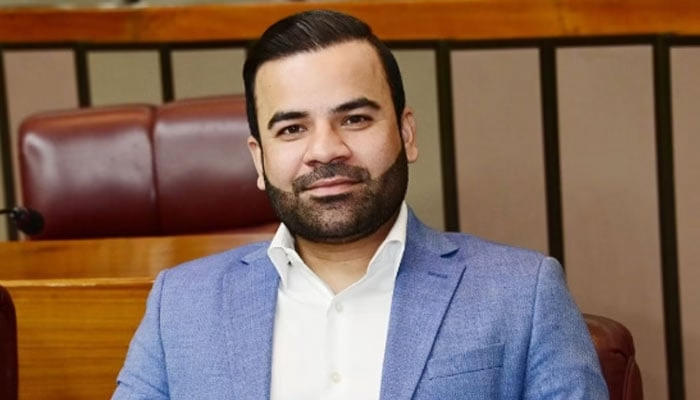
The ongoing political debate around internal party decision-making took a new turn after Barrister Aqeel Malik reaffirmed that PML-N Nawaz Sharif consultations remain central to all major choices made by the Pakistan Muslim League-Nawaz. Speaking during a televised interview, the Minister of State for Law and Justice dismissed speculation that the party had sidelined its three-time former prime minister, asserting that Nawaz Sharif continues to guide policy, governance priorities, and political strategy.
Nawaz Sharif Still at the Helm of Decision-Making
Aqeel Malik made it clear that the PML-N’s direction is firmly rooted in PML-N Nawaz Sharif consultations, emphasizing that every significant decision goes through consultation with the party’s elder statesman. Malik reiterated that Nawaz Sharif remains an active and respected voice within the party, contributing strategic insights on governance, economic reforms, and national politics.
He stressed that the PML-N’s political philosophy is based on service to the people, a legacy Nawaz Sharif shaped during his tenure. From expanding the motorway network to steering Pakistan toward nuclear capability, Malik highlighted achievements that he believes reflect Nawaz Sharif’s long-term vision for national stability.
PML-N Highlights Its Legacy of National Development
Speaking on the show, Malik defended the PML-N’s contributions to Pakistan’s progress. He listed key milestones, arguing that the party never compromised on national dignity or sovereignty. According to him, economic reforms, infrastructure development, and the strengthening of democratic institutions have long been core components of the party’s agenda.
Once again, the minister linked this continuity of policy to PML-N Nawaz Sharif consultations, saying that Nawaz Sharif’s experience, particularly during historic events like Pakistan’s nuclear tests, continues to shape how the party governs.
Sharp Criticism of PTI’s Leadership and Internal Dynamics
Aqeel Malik used the platform to draw sharp contrasts between PML-N and PTI. Referring to the events of May 9 and May 28, he stated that PML-N believes in national pride and responsible politics, whereas he accused PTI of creating instability.
He questioned the PTI founder’s decision to approach the IMF regarding election audits — a move many critics viewed as damaging to national interests. Malik contrasted this with what he described as the responsible, nation-first approach rooted in PML-N Nawaz Sharif consultations, asking rhetorically whether Nawaz Sharif had ever taken such a step that could harm the country economically.
According to Malik, PTI’s internal system lacks genuine democratic processes. He claimed that several PTI members privately express the desire for political solutions but are unable to speak freely due to restrictive leadership.
Discussion on Governor’s Rule in Khyber Pakhtunkhwa
The minister also commented on the possibility of imposing governor’s rule in Khyber Pakhtunkhwa (KP). He said the idea is constitutionally valid, though the government considers it an undesirable option. Malik added that while the conversation is ongoing, the federal government has not taken a final decision.
He reiterated that political stability and constitutional continuity remain priorities — areas where, in his view, PML-N Nawaz Sharif consultations play a vital role in shaping the government’s approach.
PTI Responds: Claims of Political Oppression
Joining the same broadcast, PTI Chief Whip Amir Dogar strongly criticized the government. He argued that political persecution has reached an alarming level and accused the federal administration of undermining parliamentary processes.
Dogar described the National Assembly as a rubber stamp,asserting that the government has failed to deliver on key issues. He maintained that stolen mandates and public oppression are the core reasons behind the growing political divide. According to him, PTI members feel cornered and deprived of space to voice their concerns.
The Broader Political Landscape
The contrasting views shared by both parties highlight the tense state of Pakistani politics. On one side, PML-N leaders emphasize stability, institution-building, and strategic continuity through PML-N Nawaz Sharif consultations. On the other side, PTI leaders accuse the government of repression and political unfairness.
As Pakistan continues navigating economic challenges, governance issues, and regional pressures, the role of political leadership—and especially Nawaz Sharif’s influence remains at the center of debate. The reaffirmation of his involvement in party affairs may strengthen internal unity within the PML-N, while also shaping its narrative heading into future political battles.
The remarks by Barrister Aqeel Malik underline that PML-N Nawaz Sharif consultations remain a defining part of the party’s decision-making framework. Whether addressing national development, party strategy, or governance challenges, Nawaz Sharif continues to play a pivotal role. As tensions with PTI persist, the political narrative will likely continue to revolve around leadership legitimacy, constitutional governance, and national priorities all of which are deeply influenced by the PML-N’s internal structure and long-held traditions.