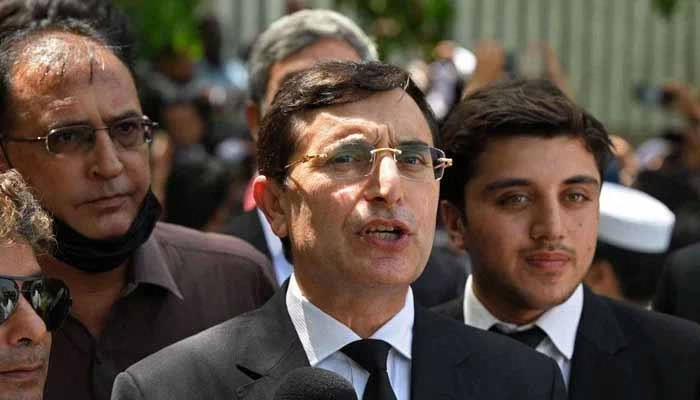
Barrister Gohar Ali Khan expressed disappointment over the tone of the ISPR briefing, clarifying that PTI has never taken an anti-state approach. He stated that the party’s criticism has always been focused on reforms and accountability, not confrontation with institutions. According to him, Pakistan and its military are shared assets of all citizens, and trust can only be rebuilt through engagement, not hostility.
He also pointed out that rising tension in PTI–Military Relations harms the country more than any political party. Gohar urged all sides to stop treating political disagreements as attacks on patriotism, as such narratives deepen mistrust and push the nation toward further division.
The Importance of Dialogue in a Divided Political Environment
Pakistan’s political landscape has remained tense for months, with fast-changing messages and hardened positions. Gohar Ali Khan warned that continuing on this path only widens gaps between political leadership and state institutions. He noted that actors with no real interest in national unity often benefit from such divisions, making healthy communication even more crucial.
He emphasized that rebuilding trust is only possible through consistent dialogue. With PTI founder Imran Khan and Bushra Bibi still imprisoned, Gohar urged authorities to allow them proper meeting rights, arguing that this would help reduce friction and create an atmosphere more suitable for reconciliation.
ISPR’s Briefing: A Turning Point in Political Discourse
The ISPR DG’s press conference became a major talking point in the discussion surrounding PTI–Military Relations. He accused the PTI founder of spreading anti-army narratives and running coordinated digital networks targeting the military. These statements added new pressure to an already difficult political environment.
The ISPR DG also spoke about an alleged online campaign supported by foreign platforms, which he said amplified anti-institution messaging. These claims intensified political reactions across Pakistan, with PTI leaders rejecting the idea that disagreement or criticism should be interpreted as hostility toward the state.
Government Reaction: New Restrictions and Firm Measures
Hours after the ISPR briefing, the federal government announced stronger restrictions concerning PTI communication. Information Minister Attaullah Tarar stated that meetings with Imran Khan in Adiala Jail would be limited further, calling it necessary to prevent the spread of harmful political narratives.
These decisions showed how sensitive PTI–Military Relations have become. Each move—from official statements to administrative restrictions—directly affects the overall political environment and shapes public perception.
A Growing Demand for Stability and Constructive Dialogue
With Pakistan’s economic and security challenges mounting, the country cannot afford prolonged political confrontation. Rising inflation, governance issues, and external pressures already require unified national focus. In such circumstances, deepening tension between PTI and state institutions only complicates the path forward.
Analysts believe that even limited reconciliation could help restore public confidence. Without constructive engagement, institutional strain may continue to rise, affecting decision-making at every level. A cooperative atmosphere would allow political leaders and institutions to shift their attention to essential reforms and public welfare.
What Comes Next for Pakistan?
The future of PTI–Military Relations depends largely on the choices political and institutional leaders make in the coming months. If both sides show willingness to communicate, acknowledge each other’s concerns, and avoid inflammatory statements, Pakistan may begin moving toward a more stable political environment.
If, however, the current cycle of accusations and restrictions continues, the divides may deepen further. The coming period will be critical in determining whether Pakistan leans toward collaboration or greater polarization.