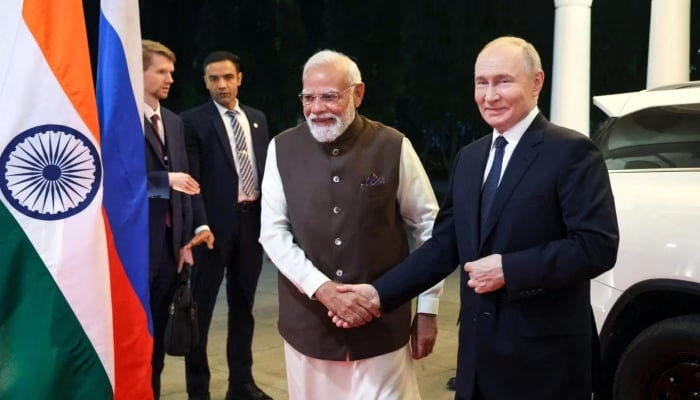
The latest India Russia summit in New Delhi marks a pivotal moment for both nations as President Vladimir Putin and Prime Minister Narendra Modi meet to strengthen economic, defence, and diplomatic cooperation. Taking place during a period of global geopolitical tension, the summit underlines the resilience of the decades-old partnership between India and Russia, even as both countries navigate Western pressure, shifting alliances, and major energy realignments.
A High-Stakes Diplomatic Visit
President Vladimir Putin’s arrival in India after four years underscores the importance of the India Russia summit for Moscow. With Western sanctions tightening in response to the ongoing conflict in Ukraine, Russia is seeking to deepen its economic engagement with long-trusted partners. India already a top buyer of Russian crude oil and defence equipment—remains one of Russia’s most significant global allies.
Prime Minister Modi welcomed President Putin with a warm embrace and private dinner at his residence, signaling the personalrapport shared by both leaders. The visit is viewed not merely as a routine diplomatic meeting but a strategic effort to reaffirm ties at a time when both nations are under increasing international scrutiny.
Trade Goals and Economic Cooperation
A key focus of the India Russia summit is trade growth, with Moscow expressing its intention to expand imports of Indian goods and balance a trade relationship heavily skewed by India’s purchases of discounted Russian oil. As European nations reduced their dependence on Russian energy, India emerged as one of the largest buyers of Russian crude.
Russia aims to increase bilateral trade to $100 billion by 2030, a target that requires diversification, logistical solutions, and enhanced cooperation across sectors. Discussions are expected to include agricultural products, machinery, pharmaceuticals, and industrial goods—areas where India has strong export potential.
Defence Partnership Remains Central
For decades, Russia has been India’s largest defence supplier, and this relationship remains a critical axis of the India Russia summit. Russia’s Defence Minister Andrei Belousov met with India’s Defence Minister Rajnath Singh to discuss ongoing projects and future collaboration.
Belousov emphasized Moscow’s readiness to support India in achieving self-reliance in defence production—a key component of India’s “Atmanirbhar Bharat” initiative. Joint production, technology transfer, maintenance support, and co-development of advanced systems remain essential components of the partnership.
As India diversifies its defence suppliers, including stronger ties with the United States, Russia is focused on ensuring that its role remains significant. The summit aims to reaffirm defence cooperation while opening doors to new areas such as aerospace, logistics, and advanced military technology.
Balancing the U.S. and Russia
One of the most complex aspects of the India Russia summit is India’s strategic balancing act between Washington and Moscow. India’s strengthening relationship with the U.S. includes defence agreements, tech partnerships, and a potential trade deal aimed at reducing tariffs imposed during the Trump administration.
However, as analyst Michael Kugelman notes, India faces a “conundrum.” Strengthening ties with one superpower often raises concerns with the other. The summit highlights India’s unique diplomatic path: maintaining historic relations with Russia while deepening partnerships with Western nations.
Despite pressure from the U.S. and its allies, India has avoided condemning Russia’s actions in Ukraine. Instead, New Delhi has consistently called for diplomacy, dialogue, and a peaceful resolution.
Energy: The Backbone of Today’s Partnership
The India Russia summit also focuses heavily on energy security. Since the Ukraine conflict, India has dramatically increased its purchase of discounted Russian crude, becoming a critical market for Moscow. This mutually beneficial arrangement offers India affordable energy while providing Russia with essential revenue.
Energy cooperation discussions may include long-term supply agreements, investment in refineries, and expanded collaboration in LNG, nuclear energy, and renewable technologies.
Civil Nuclear Cooperation and Labour Discussions
Beyond defence and energy, Modi and Putin are expected to address areas such as labour mobility, skilled workforce deployment, and civil nuclear energy. Existing collaborations like the Kudankulam Nuclear Power Plant demonstrate how nuclear technology remains a pillar of cooperation.
The summit is likely to outline future projects, workforce exchanges, and technology sharing mechanisms that strengthen long-term economic ties.
A Partnership Under Pressure but Still Strong
Despite global tensions, the India Russia summit showcases the strength, adaptability, and strategic depth of their relationship. Even as Russia engages with U.S. envoys on possible Ukraine negotiations, and India works closely with Western nations, both governments remain committed to maintaining their historic ties.
India is determined to pursue a foreign policy that is independent, interest-based, and strategically diversified. Russia, facing isolation from the West, values India as a reliable partner willing to engage without political preconditions.
The India Russia summit serves as a reminder that the partnership between New Delhi and Moscow remains vital on multiple fronts—defence, energy, trade, and diplomacy. As global power dynamics continue to evolve, the summit highlights the importance of strategic autonomy and balanced foreign policy in shaping India’s global role.