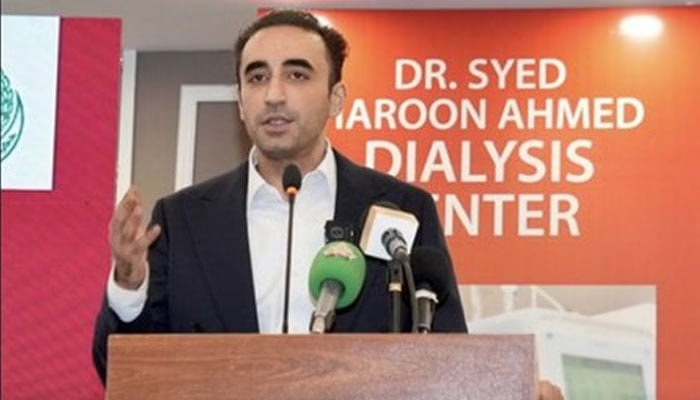
The recent Bilawal Bhutto criticism of the federal government has sparked a fresh debate over provincial autonomy in Pakistan. Speaking at the inauguration of a new SIUT unit in Karachi, the Pakistan Peoples Party (PPP) chairman accused Islamabad of attempting to reclaim powers related to education and population welfare sectors that were constitutionally handed to provinces after the 18th Amendment. His remarks have revived discussions on the delicate balance of power between the Centre and the provinces.
Federal vs Provincial Powers: A Growing Tension
During his address, Bilawal warned that any attempt to roll back provincial rights would be considered an attack on the integrity of the 18th Amendment. He argued that education and population welfare are critical provincial subjects, and pulling them back to federal control would undermine years of constitutional progress. This Bilawal Bhutto criticism reflects the PPP’s longstanding stance: the 18th Amendment is a red line that must not be crossed.
The PPP chairman reminded the audience that provincial empowerment did not come easily. Before the 18th Amendment, provinces struggled with insufficient control over essential public services. Today, he said, Sindh stands as an example of how devolution can strengthen governance, especially in the health sector.
Sindh’s Healthcare Transformation
Bilawal highlighted that healthcare facilities across Sindh have significantly improved over the past decade. New hospitals, refurbished units and expanded services, including SIUT and NICVD branches, now provide free treatment to millions of citizens. These institutions have earned recognition for their international standards and people-centric approach.
In his Bilawal Bhutto criticism of previous federal administrations, he recalled how the Centre once attempted to take NICVD away from Sindh during the PTI government. The PPP strongly resisted those moves, arguing that any reversal would disrupt essential services and hinder the progress made under devolved powers.
Demand for Province-to-Province Learning
Bilawal revealed that a PPP ticket holder from Punjab recently reached out to him and Sindh Chief Minister Murad Ali Shah, requesting that Sindh-style free healthcare models be extended to regions outside the province. For Bilawal, this was proof that devolution works and that other provinces also recognise the success of Sindh’s healthcare transformation.
This moment, he said, underscores why constitutional changes should strengthen provincial governments instead of weakening them.
Critique of KP’s Health Card System
Another strong Bilawal Bhutto criticism targeted the health card programme in Khyber Pakhtunkhwa (KP). He argued that instead of investing directly in government hospitals, the KP government redirected its health budget toward private healthcare providers. This shift, according to him, raises concerns about transparency, sustainability and the long-term impact on the provincial health system.
Bilawal questioned whether the move benefits citizens or prioritizes private entities. He called on the KP and federal governments to present their 15-year population planning data, asserting that Sindh is ready to share its own record. His challenge signals a broader demand for accountability and transparency across provinces.
Defense of the 18th Amendment
Bilawal has repeatedly emphasized that any effort to undo or dilute the 18th Amendment would be met with strong resistance. Last week, he warned that those seeking to reverse the amendment or alter the NFC Award were playing with fire. This Bilawal Bhutto criticism aligns with the PPP’s core political ideology, which centers on provincial empowerment.
He stressed that no amendment since 1973 has been as transformative as the 18th Amendment, which devolved education, health, agriculture, population planning and several other critical areas to the provinces. For the PPP, the amendment is not simply a law — it is a symbol of democratic progress and federal harmony.
Political Implications Moving Forward
These remarks come at a time when national debates over resource allocation, governance efficiency and inter-provincial relations are intensifying. Bilawal’s firm tone suggests that the PPP is preparing to position itself as the strongest defender of provincial rights in Pakistan’s evolving political landscape.
The Bilawal Bhutto criticism also signals the PPP’s intent to challenge any centralizing tendencies within the federal government. By linking healthcare achievements directly to devolved powers, he is shaping a narrative that the provinces perform better when empowered, not constrained.
The ongoing Bilawal Bhutto criticism of federal overreach highlights deep-rooted concerns about constitutional integrity, governance and public welfare. His speech at the SIUT inauguration not only defended Sindh’s progress but also reinforced the PPP’s commitment to protecting the 18th Amendment. As debates over provincial autonomy continue, Bilawal’s message is clear: attempts to centralize power will face strong political resistance, and the future of Pakistan’s governance depends on respecting the rights of its provinces.