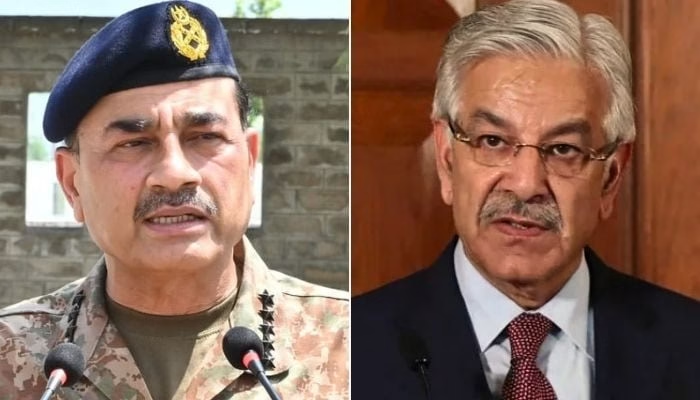
The appointment of the Chief of Defence Forces (CDF) has become the centre of public discussion in recent days, especially after Defence Minister Khawaja Asif addressed the increasing speculation surrounding the notification. The government has created this new and powerful position through the 27th Constitutional Amendment, and clarity on the role of the Chief of Defence Forces is essential to understand Pakistan’s evolving military structure.
Clarifying the Appointment Process
Speaking on Sunday, Defence Minister Khawaja Asif categorically rejected all rumours about an imminent notification regarding the Chief of Defence Forces. He stated that the process has already begun and will be completed in due time. According to Asif, There is unnecessary and irresponsible speculation, adding that the prime minister will oversee the process once he returns to the country.
The government intends to ensure that the appointment of the Chief of Defence Forces is carried out in a responsible and transparent manner. The minister stressed that there is no room for conjecture, as the procedure follows the constitutional amendments and established legal framework.
The New Role of Chief of Defence Forces
The position of the Chief of Defence Forces has been introduced after abolishing the Chairman Joint Chiefs of Staff Committee (CJCSC). This major restructuring reflects Pakistan’s aim to unify strategic decision-making and strengthen multi-domain coordination among the armed forces.
Under the amended structure, Field Marshal Asim Munir — currently serving as the Chief of Army Staff (COAS) — will also take on the responsibilities of the CDF. This dual designation places him at the centre of Pakistan’s defence strategy.
The government will define the duties, powers, and responsibilities of the Chief of Defence Forces. These responsibilities may include:
- Improving joint operations of the armed forces
- Enhancing multi-domain military integration
- Overseeing defence restructuring
- Ensuring operational alignment for all service branches
This new framework aims to modernize Pakistan’s military leadership and improve strategic cohesion between the Army, Air Force, and Navy.
A New Chapter in Military Leadership
Field Marshal Asim Munir’s elevation to Pakistan’s highest honorary rank earlier this year marked a historic milestone. He became the country’s second field marshal in more than 60 years — a promotion granted after Pakistan’s significant military success during the May conflict.
Beginning November 28, Field Marshal Munir will officially be addressed as both the COAS and the Chief of Defence Forces, combining operational and strategic leadership under a unified position. This change will be reflected in all official paperwork, military references, and media coverage.
The tenure of the COAS will also restart for another five years once the new notification is issued, ensuring continuity in military leadership.
What the Constitutional Amendment Means
The 27th Constitutional Amendment has introduced substantial reforms, with the most prominent being the formation of the CDF post. Additionally, new honorary titles such as Field Marshal, Marshal of the Air Force, and Admiral of the Fleet have been introduced to recognize exceptional service in the armed forces.
A key aspect of the amendment is that only the parliament has the authority to revoke these honorary ranks or impeach the military chiefs. This step ensures democratic oversight while maintaining institutional stability.
Moreover, the prime minister will appoint the commander of the National Strategic Command on the recommendation of the Chief of Defence Forces, strengthening the role of the CDF in key national security decisions.
Why the CDF Appointment Matters
The new role of the Chief of Defence Forces is expected to bring structural improvements and operational efficiency within Pakistan’s defence framework. With threats evolving across regional and global landscapes, Pakistan aims to build a command structure that reflects modern warfare needs.
A unified command — headed by the Chief of Defence Forces — supports:
- Stronger strategic planning
- Better communication between defence branches
- More effective resource utilization
- Coordinated responses to national security challenges
The debate surrounding the appointment of the Chief of Defence Forces highlights its importance in shaping the future of Pakistan’s defence strategy. While speculation has grown, Defence Minister Khawaja Asif’s statement confirms that the process is underway and will proceed strictly according to constitutional guidelines. As Pakistan transitions into this new defence structure, the role of the Chief of Defence Forces will remain central to ensuring unity, preparedness, and strategic strength for the nation.