In a major step toward repairing strained ties, Canada and India have agreed to begin negotiations on a comprehensive new free trade agreement, Canadian Prime Minister Mark Carney announced on Sunday. The development marks a notable warming of relations between the two countries after a prolonged diplomatic standoff that began in 2023.
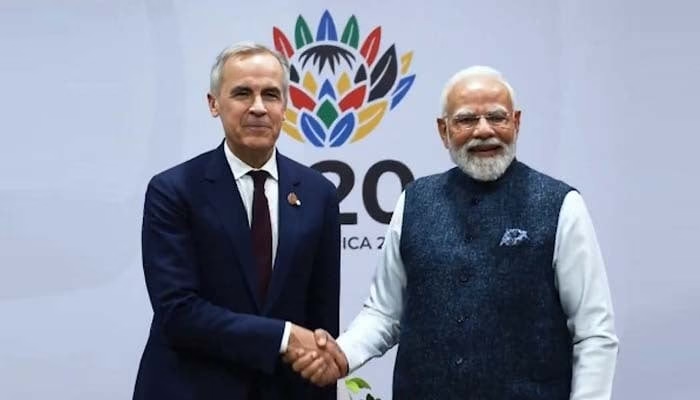
Carney’s office confirmed the breakthrough shortly after he met Indian Prime Minister Narendra Modi on the sidelines of the G20 summit in South Africa. The meeting, described by officials as constructive and forward-looking, centered on trade expansion, regional cooperation, and efforts to mend the deep diplomatic rift that had severely strained bilateral ties.
Background of the Dispute
Relations between Ottawa and New Delhi deteriorated sharply in 2023 when Canada publicly accused the Indian government of involvement in the assassination of Hardeep Singh Nijjar, a Canadian Sikh leader and prominent Khalistan activist, who was shot dead outside a gurdwara in Vancouver. India unequivocally rejected the allegations, calling them “absurd” and “politically motivated.”
The disagreement escalated rapidly, leading to restrictions on consular operations, delays in visa processing, and disruptions in trade talks. The fallout created a diplomatic freeze that impacted not only government-level engagement but also business communities and diaspora relations.
Trade between the two nations, which amounted to about $9 billion (CAN$12.3 billion) in goods and services in 2023, also suffered as tensions lingered. Both sides paused earlier negotiations on a trade agreement, and diplomatic communication became increasingly limited.
A New Approach Under Mark Carney
Since taking office in March, Prime Minister Mark Carney has adopted a more open, globally engaged trade policy. He has repeatedly emphasized the importance of diversifying Canada’s economic partnerships, particularly as the United States — Canada’s largest trading partner has imposed heavy tariffs on important Canadian exports in energy, agriculture, and manufacturing.
Carney has argued that expanding trade with dynamic Indo-Pacific economies such as India is essential if Canada wants to shield itself from economic vulnerability. His meeting with Prime Minister Modi is seen as part of a broader strategy to reset relations with India while creating new avenues for trade-led growth.
Talks on an “Ambitious” Free Trade Agreement
In a statement released after the meeting, Carney said he and Modi had agreed to launch discussions on an “ambitious” free trade deal aimed at significantly boosting economic cooperation.
According to Carney, the proposed agreement seeks to double bilateral trade to CAN$70 billion by 2030, a goal that underscores the scale of opportunity both nations see in expanding the partnership.
The trade pact is expected to focus on several core sectors, including technology, agriculture, clean energy, skilled labor mobility, and critical minerals an area in which Canada holds some of the world’s largest reserves essential for global green-energy transitions.
Carney to Visit India Next Year
In another sign of improving relations, the Canadian prime minister also accepted Modi’s invitation to visit India early next year. The visit is expected to formalize the launch of trade negotiations and may include meetings with industry leaders, business chambers, and provincial/state authorities.
Diplomats believe the visit could serve as a turning point in rebuilding confidence and reestablishing a high-level communication channel that had been missing for nearly two years.
Impact of the Sikh Diaspora Issue
Canada is home to the largest Sikh population outside India, comprising over 770,000 people, many of whom maintain strong political and cultural ties to Punjab. A section of this population supports Khalistan — a fringe separatist movement seeking an independent Sikh state.
The Nijjar assassination case, along with Ottawa’s claims that Sikh activists face threats from foreign agencies, has complicated Canada–India relations for decades. Several Western countries with significant Sikh populations — including the UK, Australia, and the US — have also expressed concern over the issue.
While the matter remains sensitive, officials say the renewed diplomatic engagement shows both sides are willing to compartmentalize disagreements in order to move forward on strategic and economic cooperation.
A Step Toward Normalization
Analysts view the decision to restart trade talks as a pragmatic move from both governments. For Canada, tapping into India’s expanding economy aligns with its long-term trade diversification goals. For India, improving relations with Ottawa strengthens its ties with Western economies and boosts its global image as a stable trade partner.
While the road to full normalization may still contain challenges, the agreement to open talks on a new free trade pact signals a clear shift in tone. Both sides appear ready to rebuild trust, restore dialogue, and pursue mutually beneficial economic growth.