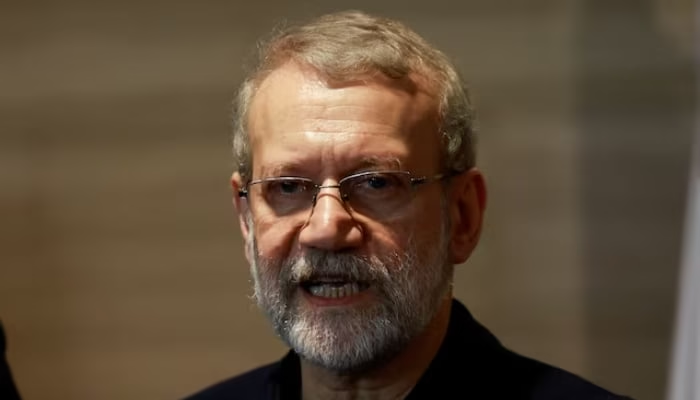
In a significant diplomatic development, Dr Ali Larijani the adviser to Iran’s Supreme Leader and the secretary of the Supreme National Security Council (SNSC) is set to undertake what Iranian officials describe as an “unprecedented visit to Pakistan.” The announcement, made on Monday by Iran’s Ambassador to Pakistan Reza Amiri Moghadam, has sparked considerable interest in both countries, as it comes at a time of shifting geopolitical currents and renewed regional alignments.
In a detailed post on X (formerly Twitter), Ambassador Moghadam emphasised the pivotal nature of Larijani’s upcoming trip, noting that the visit would help elevate the “time-tested” relationship between Pakistan and Iran to a new strategic phase. According to him, both countries stand at an important juncture where geopolitical challenges, emerging regional dynamics, and rapidly changing global realities demand strengthened bilateral coordination.
The ambassador stated that Larijani’s engagement in Pakistan would focus on strategising long-term cooperation, enhancing mutual security frameworks, and advancing the shared objective of deeper political and economic ties. He underscored that this visit is not just symbolic but forms part of a broader vision to push Pakistan–Iran relations towards more structured and future-oriented collaboration.
Before the official announcement by Iran’s envoy, Dr Ali Larijani himself confirmed his upcoming trip through a message written in Urdu a gesture widely appreciated in Pakistan. In his post, Larijani expressed deep gratitude for Pakistan’s support during Iran’s moments of crisis, particularly recalling the 12-day conflict imposed on Iran earlier in the year by the United States and Israel.
He wrote that the Iranian people “will never forget” how the Pakistani nation stood by Iran during those critical days. This reference highlights the emotional and historic bonds between the two nations, which have often found themselves aligned on major regional issues.
Larijani further stressed that both Pakistan and Iran hold significant positions in the region when it comes to sustaining long-term peace and stability. He reiterated Iran’s longstanding policy of seeking fraternity and cooperative ties with neighbouring and regional countries, asserting that partnerships rooted in mutual respect are essential for confronting shared challenges.
Pakistan’s Ambassador to Iran, Muhammad Mudassir Tipu, also welcomed the announcement of Larijani’s visit. In his post on X, Ambassador Tipu described the upcoming trip as part of a series of extensive engagements between the leadership of the two nations. According to him, the visit holds immense importance for reinforcing the “historical and deep-rooted ties” that Pakistan and Iran have preserved over the decades.
The strengthening of Islamabad–Tehran relations has been especially visible in recent months. During the 12-day Iran–Israel conflict in June, Pakistan emerged as one of Iran’s staunchest supporters on the global stage. The conflict had erupted on June 13, when Israel launched an intensive bombing campaign targeting Iranian military commanders and nuclear scientists. Iran retaliated with ballistic missile strikes on Israeli cities, leading to regional tensions and international concern.
Throughout the crisis, Pakistan adopted a clear position in support of Iran. Pakistani officials repeatedly condemned the attacks on Iranian territory and voiced support for Iran’s right to defend itself. Interior Minister Mohsin Naqvi later revealed that Prime Minister Shehbaz Sharif played an instrumental role in brokering a ceasefire between Iran and Israel, facilitating communication channels and urging a halt to hostilities.
In the aftermath of the ceasefire, Iranian President Masoud Pezeshkian personally thanked Prime Minister Shehbaz Sharif during a telephonic conversation. He expressed appreciation for Pakistan’s consistent and “principled stance” in supporting Iran during a highly sensitive period.
Against this backdrop of political cooperation, Larijani’s forthcoming visit is being viewed as a continuation of the momentum built between the two countries. Analysts believe that discussions during the visit may include border security, counterterrorism, trade expansion—particularly through the Pakistan–Iran gas pipeline—and broader regional coordination involving Afghanistan and the Gulf region.
As both nations navigate an era of shifting alliances, the visit is expected to solidify a renewed chapter in Pakistan–Iran strategic relations. The emphasis on dialogue, cooperation, and shared regional interests reflects the growing recognition that stability in South and West Asia depends heavily on strong bilateral partnerships among neighbouring states.