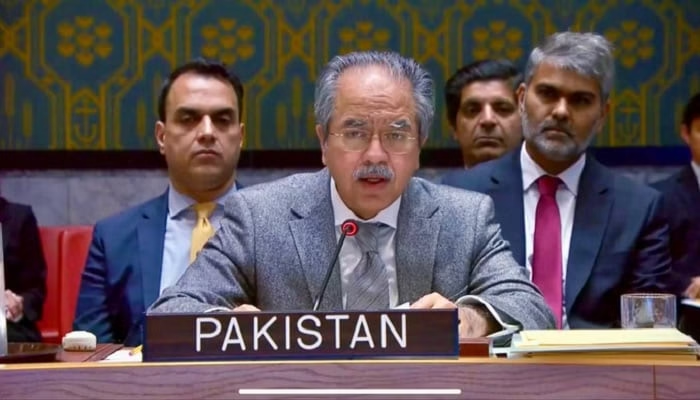
Pakistan has once again urged the international community to take urgent and unified action against the escalating Afghan weapons flow, warning that the unchecked movement of illegal and advanced arms inside Afghanistan is creating a dangerous security challenge for the entire region. Speaking at the UN Security Council Open Debate on Small Arms, Pakistan highlighted how these weapons are finding their way into the hands of militant outfits operating against Islamabad and destabilising South Asia.
Growing Security Threats Linked to Illegal Arms
Ambassador Asim Iftikhar Ahmad, Pakistan’s Permanent Representative to the United Nations, cautioned that large stockpiles of modern weapons within Afghanistan pose a direct threat to neighbouring states. Many of these arms, he noted, were left behind by foreign forces or have entered black markets, creating an environment where extremist groups can easily access sophisticated firepower.
He stressed that despite recent ceasefires and dialogues between Pakistan and Afghanistan, militant outfits continue to exploit the situation. Groups such as Daesh-K, TTP, BLA, and the Majeed Brigade have reportedly used these advanced weapons in deadly attacks on Pakistani civilians and security personnel. The deteriorating situation has deepened tensions between Islamabad and Kabul, making the issue of the Afghan weapons flow a central point of concern.
Impact on Pakistan’s Internal Security
Pakistan has repeatedly voiced concerns over the presence and continued activity of anti-Pakistan groups operating from Afghan soil. According to the ambassador, the weapons retrieved from terrorists inside Pakistan can be traced back to Afghan stockpiles—evidence that illegal arms are moving freely across the border.
This flow of unmarked and unregistered weapons, he said, sustains non-state armed groups and enables criminal networks. As a result, Pakistan’s counter-terrorism operations are becoming more difficult, and the region’s stability remains at risk. The Afghan weapons flow has therefore become a major obstacle to long-term peace, especially when extremist groups continue to act with impunity.
Regional and Global Implications
While the immediate impact is felt in Pakistan, the ambassador emphasised that the threat is much broader. Illicit small arms and light weapons are known to intensify conflicts worldwide, prolong violence, and derail socio-economic development. Globally, these weapons are the second most used tools in terrorist attacks, making their proliferation a serious international security issue.
The ambassador pointed out that Africa serves as a stark example. The continent has been heavily affected by illegal arms used by armed groups, criminal networks, and militias. These weapons fuel internal conflicts, political violence, and organised crime, eroding governance structures and harming economic progress. The situation, he argued, mirrors the dangers posed by the Afghan weapons flow in South Asia.
Advanced Technology Increasing the Challenge
Another pressing concern raised at the UN debate was the rapid advancement of military technologies. Modern weapons, including drones, AI-driven systems, and 3D-printed firearms, are becoming increasingly accessible to non-state actors. Criminal groups and terrorists have also turned to cryptocurrency and the dark web to facilitate anonymous transactions, making arms tracking even more difficult.
Ambassador Ahmad warned that traditional arms control frameworks are no longer sufficient in the face of such technological evolution. Countries must update their policies and adopt new tools to manage the emerging threats. Without modernised control mechanisms, there is a risk that the Afghan weapons flow and similar crises will worsen.
Call for Global Cooperation
Pakistan urged the international community to significantly strengthen efforts to prevent extremist groups from accessing illicit weapons. Islamabad stressed that the Afghan interim authorities must honour their international commitments and take concrete action against terrorist organisations operating within Afghanistan.
The ambassador highlighted the importance of fully implementing the United Nations Programme of Action on the Illicit Trade in Small Arms and Light Weapons. He described the programme as a balanced framework that considers both the legitimate security needs of states and the urgency of stopping illegal weapons transfers.
The rising Afghan weapons flow is not just a bilateral challenge between Pakistan and Afghanistan—it is a regional and global security issue that demands coordinated international action. As militant groups continue to acquire advanced weaponry, the dangers to peace, development, and civilian safety increase. Pakistan’s call at the UN underscores the need for stronger global responses, updated control strategies, and meaningful cooperation to prevent illicit arms from fueling instability across borders.