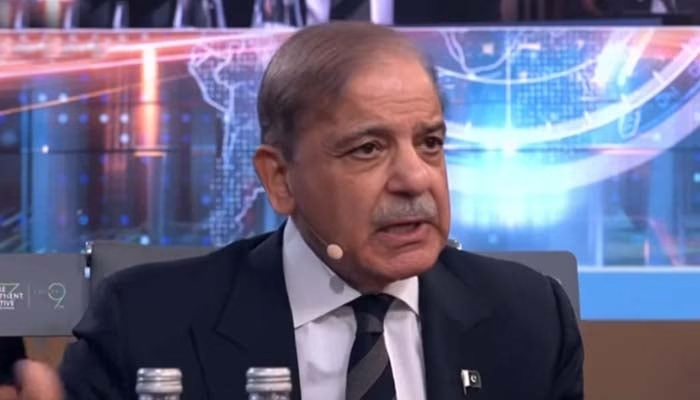
Prime Minister Shehbaz Sharif revealed that Pakistan has suffered economic losses amounting to $130 billion due to climate-induced disasters, despite contributing less than a fraction of 1% to global carbon emissions. Speaking at the 9th Future Investment Initiative (FII) Conference 2025 in Riyadh, PM Shehbaz Sharif underscored that Pakistan remains among the world’s most climate-affected nations through no fault of its own,calling for global solidarity in addressing the disproportionate impact of climate change on developing countries.
Pakistan’s Minimal Emissions and Massive Climate Damage
During the roundtable discussion titled Is Humanity Heading in the Right Direction?, PM Shehbaz Sharif reminded participants that Pakistan’s carbon emissions are negligible, yet the country continues to face devastating floods, storms, and other climate-related disasters. Recalling the catastrophic 2022 floods, he said that vast areas of agricultural land were submerged, homes were destroyed, and millions of livelihoods were affected. These events forced Pakistan to rely heavily on foreign loans for reconstruction and recovery.
He described the recurring pattern of progress and setback as like going up the ladder and then coming back down, lamenting that hard-earned national gains are repeatedly reversed by natural calamities. The PM Shehbaz Sharif emphasized that these challenges are not of Pakistan’s making but stem from global environmental negligence.
Rebuilding Through Borrowing: A Cycle That Must End
The prime minister highlighted the economic vulnerability of developing countries like Pakistan, explaining that the only option to rebuild after such disasters has been external borrowing. However, PM Shehbaz Sharif stressed that taking more loans is not a sustainable solution. We must stand on our own feet, he said, noting that Pakistan is implementing long-term strategies to reduce dependency and build climate resilience.
He called on wealthier nations to play their part in sharing the financial and technological burdens, pointing out that those who contribute most to global emissions should assist those who bear the consequences.
Global Call for Shared Responsibility
In his address, PM Shehbaz Sharif urged the international community to take collective responsibility for mitigating climate damage and supporting countries disproportionately affected. The global community must come to the rescue of humanity, he stated, emphasizing the moral and humanitarian obligation of developed nations to help vulnerable economies recover and adapt.
Acknowledging that Pakistan has made mistakes in the past, he reassured participants that his government is committed to transparent governance and robust institutional reform. We are implementing deep-rooted reforms to ensure sustainable growth and accountability,said the prime minister, adding that the government has fully digitalized the Federal Board of Revenue (FBR) and is strengthening anti-corruption mechanisms.
Pakistan’s Youth: A Challenge and an Opportunity
Discussing the demographic advantage, PM Shehbaz Sharif noted that nearly 60% of Pakistan’s population consists of youth — a group that represents both a challenge and a vast opportunity. He emphasized that the government aims to empower young people through skill development, innovation, and technology integration. By investing in education and digital literacy, the government hopes to turn Pakistan’s youthful energy into a driving force for national progress.
The prime minister urged the global community to extend support to developing nations like Pakistan, which are simultaneously battling climate crises and striving for economic growth. He asserted that collaboration and technology-sharing among nations are essential to ensure global progress.
Vision for a Digitally Empowered and Sustainable Pakistan
Highlighting his vision for the future, PM Shehbaz Sharif vowed to transform Pakistan into one of the fastest-growing countries by leveraging natural resources and human potential. He stated that the government’s focus is on fostering innovation, renewable energy, and green infrastructure to drive inclusive growth while protecting the environment.
Responding to a question about the rise of artificial intelligence (AI), PM Shehbaz Sharif acknowledged that Pakistan is rapidly adopting AI due to its immense potential to revolutionize industries and governance. However, he cautioned that while AI offers vast opportunities, it also presents ethical and economic challenges that require global collaboration.
Call for Global Dialogue on AI and Technology Ethics
PM Shehbaz emphasized the importance of engaging in a constructive dialogue between the Global North and Global South to ensure that AI is used responsibly. He stated that technology should serve as a tool for equality, not division, and called for synergy among nations to maximize AI’s positive impact. We must ensure that the benefits of technology reach everyone,he said, urging industrialized countries to share innovations and knowledge with developing economies.
A Call for Global Solidarity and Reform
In his concluding remarks, PM Shehbaz Sharif reiterated that climate resilience and economic recovery are interconnected goals that require both domestic reform and international cooperation. He expressed confidence that Pakistan’s commitment to transparency, reform, and digital transformation will pave the way toward a more sustainable and equitable future.
At the FII Conference 2025, PM Shehbaz Sharif delivered a clear message — that global challenges like climate change and technological disruption demand shared solutions. With Pakistan standing on the frontlines of the climate crisis despite minimal emissions, his appeal for fairness, innovation, and collaboration resonated as both a warning and a call to action for the international community.