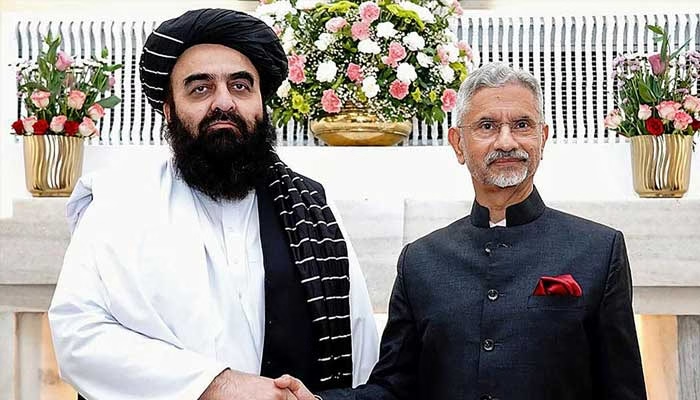
The Modi government backlash continues to grow after women journalists were barred from attending Afghan Foreign Minister Amir Khan Muttaqi’s press conference in New Delhi — a move that has sparked outrage across India’s political and media circles. The incident, which took place at the Afghanistan Embassy in Delhi, has been widely condemned as a setback for women’s rights and press freedom in the world’s largest democracy.
According to Indian media reports, security personnel and Delhi Police officials prevented several women reporters from entering the venue despite repeated requests. The event, attended by male journalists, took place during Muttaqi’s six-day visit to India — his first since the Taliban returned to power in Afghanistan in 2021.
The Incident That Sparked the Modi Government Backlash
The Modi government backlash gained momentum after reports surfaced that the exclusion of women journalists occurred during a press briefing organized by the Afghan Embassy. The event coincided with India’s announcement to reopen its embassy in Kabul, signaling a renewed engagement with Afghanistan’s Taliban administration.
The United Nations Security Council (UNSC) had granted Muttaqi a temporary exemption from international travel restrictions to allow his diplomatic visit to India. His presence was seen as a significant milestone in India-Afghanistan relations — but the press conference controversy quickly overshadowed the diplomatic discussions.
Women reporters who attempted to attend the event claimed they were stopped by embassy security staff and local police. Several prominent news outlets reported that despite multiple appeals, no explanation was provided for the exclusion, raising serious concerns about gender discrimination and freedom of the press.
Political and Public Outrage Across India
The Modi government backlash intensified as opposition leaders condemned the silence of the ruling administration. Congress leader Rahul Gandhi took to X (formerly Twitter), accusing Prime Minister Narendra Modi of failing to defend women’s rights.
“Mr. Modi, when you allow the exclusion of women journalists from a public forum, you are telling every woman in India that you are too weak to stand up for them,” Gandhi wrote. He further added that such incidents expose “the emptiness of Modi’s slogans on Nari Shakti [woman power].”
Priyanka Gandhi, another senior Congress figure, demanded a formal clarification from the government. She questioned whether the administration’s repeated claims about empowering women were merely “convenient posturing from one election to the next.”
Former Finance Minister P. Chidambaram also weighed in, criticizing male journalists who continued attending the press conference instead of protesting. “Every male journalist present should have walked out in solidarity,” he said, calling it a test of ethical journalism.
Trinamool Congress MP Mahua Moitra went a step further, accusing the Modi regime of “disgracing every Indian woman” by allowing such discrimination on Indian soil. “By enabling this, the government has surrendered the dignity of Indian women to a foreign administration,” she declared.
Government Response and Diplomatic Clarifications
As the Modi government backlash grew, the Ministry of External Affairs (MEA) issued a statement distancing itself from the controversy. It claimed that the Indian government had “no role” in organizing the event and that the Afghan Embassy was responsible for managing its own security and guest lists.
“The Afghan Embassy is not under the jurisdiction of the Government of India,” the MEA clarified, adding that the press invitations were issued directly by Afghanistan’s Consul General in Mumbai to select journalists based in Delhi.
However, critics argue that the Indian government’s silence reflects a lack of political will to protect gender equality and press freedom. The incident, they say, contradicts India’s constitutional values and global image as a democracy that upholds women’s participation in all spheres of life.
Gender Equality and Press Freedom Under the Spotlight
The Modi government backlash over the exclusion of women journalists has reignited broader debates about gender parity in India’s media and politics. According to a 2023 UNESCO report, women constitute only 21% of journalists in India, and many face systemic barriers when covering political or diplomatic events.
This latest incident, critics warn, could further discourage women from pursuing journalism and reinforce gender bias in professional spaces. India, which ranked 108th out of 146 countries in the 2024 Global Gender Gap Index, continues to face challenges in ensuring equal opportunities for women in media and governance.
Broader Implications for India’s Global Image
Analysts suggest that the Modi government backlash could have diplomatic implications as well. By appearing to tolerate gender-based exclusion during a foreign delegation’s visit, India risks damaging its global reputation as a democratic and inclusive nation.
Furthermore, the controversy raises questions about how India balances its engagement with the Taliban regime — known for its oppressive stance on women’s rights — while upholding its own constitutional principles.
The controversy surrounding women journalists’ exclusion from the Afghan foreign minister’s press conference has become more than just a diplomatic embarrassment — it has become a test of India’s commitment to gender equality and free speech.
As the Modi government backlash continues to grow, many are calling on the administration to take a firm stand, issue a public apology, and ensure such incidents are never repeated. India’s credibility as a democracy that empowers women and defends press freedom depends not on slogans, but on actions that uphold these core values in every arena — domestic or diplomatic.